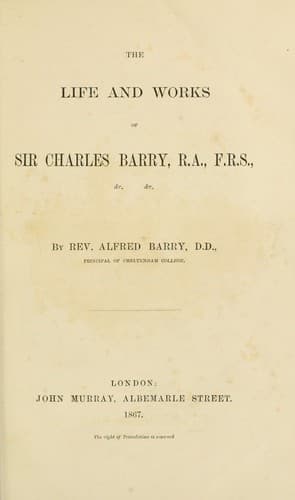
The life and works of Sir Charles BarryBarry, Alfred
General
The life and works of Sir Charles Barry
Barry, Alfred
Architects -- Great Britain -- Biography; Barry, Charles, 1795-1860
I. HISTORY OF THE GROWTH OF THE DESIGN.--Influence of external
circumstances on the design--Lowness and irregularity of
site--Limitation of choice to Elizabethan and Gothic styles--Choice
of Perpendicular style--Original conception of the plan--Question
of restoration of St. Stephen’s Chapel--Use of Westminster Hall as
the grand entrance to the building--Simplicity of plan--Principle
of symmetry and regularity dominant--Enlargement of plan after its
adoption--Conception of St. Stephen’s porch--The Central Hall--The
Royal Entrance and Royal Gallery--The House of Lords, its
construction and decoration--The House of Commons, and its
alteration--Great difficulty of the acoustic problem--Enlargement
of public requirements--Alterations of design in the River
Front--The Land Fronts--The Victoria Tower--The Clock
Tower--General inclination to increase the upward tendency of the
design, and the amount of decoration. II. BRIEF DESCRIPTION OF THE
ACTUAL BUILDING.--Its dimensions--Its main lines of approach; the
public approach--The royal approach--The private approaches of
Peers and Commons--General character of the plan--The external
fronts--The towers--Criticisms on the building by independent
authorities.
I. In considering the growth of the design of the New Palace at
Westminster, it is necessary to remember, that it was not left entirely
free, to be determined by the taste of the architect or the requirements
of the building, but was influenced by the site, by the existence of
Westminster Hall, of the Courts of Law, and of a portion of the old St.
Stephen’s Chapel, and by the limitation to either the Elizabethan or
Gothic style dictated by the judges.
The disadvantages of the site were so obvious--so obvious, that
proposals were made to rebuild the Palace on other sites, among which
may be noticed the high ground in the Green Park and Trafalgar Square.
But in the end the feeling for the old site prevailed, and architectural
effect was not unnaturally sacrificed to historical associations.
Public-domain text, read in full here on John Shaqi.
Reviews
Reviews
No reviews yet
Be the first to share your thoughts on this work.
Elsewhere in the archive
Join the Discussion
Join the discussion
Sign in to leave a comment or review.
Sign InorCreate an account