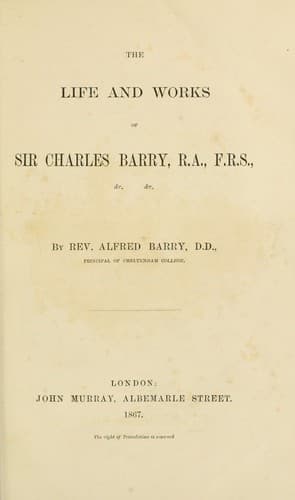
The life and works of Sir Charles BarryBarry, Alfred
General
The life and works of Sir Charles Barry
Barry, Alfred
Architects -- Great Britain -- Biography; Barry, Charles, 1795-1860
These points determined, the rest of the plan followed naturally. The
Commons must be on the left of the Central Hall, their private entrance
in New Palace Yard, and the Speaker’s residence beyond; the Lords on
the right, their private entrance in Old Palace Yard, and the Royal
approach again beyond this. The suites of libraries and committee-rooms
could nowhere be so well placed as on the river front. This general plan
was at once adopted, and from its main features he never swerved. He
disliked, as an error of principle, the necessary duality of design, and
the need of carrying on the great line of approach to inferior rooms,
while the Houses of Lords and Commons lay on the right and left. He
would have preferred some one feature incontestably the chief, so as to
give the unity which he craved. But the plan adopted was recommended by
grandeur, simplicity, and convenience;[92] and these considerations kept
him firm and unhesitating in his adherence to it. In fact, he was
surprised that none of his competitors had adopted it.
The plan and style being thus fixed, the composition of the design next
suggested the question, whether there was anything in Gothic style which
ought to interfere with the principles of symmetry, regularity, and
unity, so dear to his artistic taste. Many (and his friend Pugin
especially) contended for irregularity, picturesqueness, and variety.
They would have had a group of buildings rather than a single one, or at
any rate a building, in which there should be a general unity of style,
rather than an actual symmetry of design, which they stigmatized as
“clothing a “classical design with Gothic details.” But Mr. Barry’s
notions were widely different. He conceived that, if certain first
principles were true, they could not vary in different styles. He
believed that symmetry and regularity were essential to unity and
grandeur; and on this conviction he acted throughout, though sensible at
the time that it would meet with opposition, and occasionally
disheartened by the increasing strength of the opposition in after
years.[93] This is, of course, no place for the discussion of so
difficult a question in the abstract. All that is needful is to indicate
the principle, which, as a matter of fact, guided and controlled the
design, and which probably accounts for the existence of certain actual
features, and the omission of others which might have been looked
for.[94]
Public-domain text, read in full here on John Shaqi.
Reviews
Reviews
No reviews yet
Be the first to share your thoughts on this work.
Elsewhere in the archive
Join the Discussion
Join the discussion
Sign in to leave a comment or review.
Sign InorCreate an account