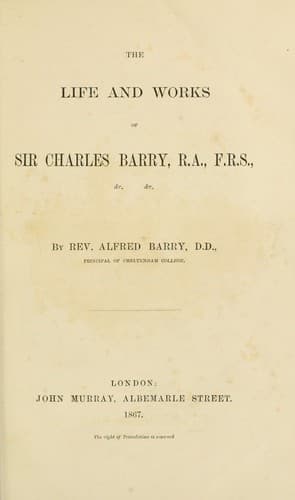
The life and works of Sir Charles BarryBarry, Alfred
General
The life and works of Sir Charles Barry
Barry, Alfred
Architects -- Great Britain -- Biography; Barry, Charles, 1795-1860
In the House of Lords no great alteration was made, except in height. In
the original design the roof was kept low, in deference to authorities
in acoustics; but on more careful inquiry it was found that they
differed widely from each other, and the architect not unnaturally
thought that certain beauty of proportion need not be sacrificed to a
doubtful acoustical advantage. The roof accordingly was raised. It could
not be made open, because of the requirements for ventilation; but, in
fact, even in Gothic buildings Mr. Barry was disinclined to employ open
roofs. For inhabited rooms he preferred a coved or arched ceiling, and
believed that, in the abstract, a cove was the best method of connecting
a horizontal ceiling with vertical walls.
In the gorgeous decorations of the house not a little was due to the
work and the influence of Mr. Pugin, which added a stimulus, hardly
needed, to the architect’s own love of enrichment. The carved and metal
work, and generally the purely ornamental details, were designed by Mr.
Pugin, under Mr. Barry’s direction, and subject to his frequent
alterations; the painted windows were not only designed by Mr. Pugin,
but carried out under his superintendence, the architect only
stipulating for a sufficient amount of white glass to produce the
“jewelled effect” he admired in many ancient windows.[98] The unsightly
black effect of these windows at night was a great difficulty; a system
of external gas-lighting was adopted to remedy it, but it has since been
disused. The ceiling was a subject of much consideration; Mr. Barry
wished to produce as much as possible the effect of solid gold, the
enrichment of colour being purely subsidiary. His notion always was that
decoration, if begun, should be thoroughly carried out, and that only by
failure in this respect, and by partiality of decoration, was the effect
of tawdriness produced.
The House of Lords he considered as not a mere place of business, not
even a mere House of Lords at all, but as the chamber in which the
sovereign, surrounded by the court, summoned to the royal presence the
three estates of the realm. He thought, therefore, that it should
partake of royal magnificence, and lavished upon it all the treasures of
decoration.
Public-domain text, read in full here on John Shaqi.
Reviews
Reviews
No reviews yet
Be the first to share your thoughts on this work.
Elsewhere in the archive
Join the Discussion
Join the discussion
Sign in to leave a comment or review.
Sign InorCreate an account