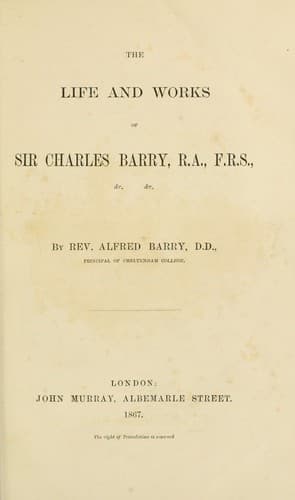
The life and works of Sir Charles BarryBarry, Alfred
General
The life and works of Sir Charles Barry
Barry, Alfred
Architects -- Great Britain -- Biography; Barry, Charles, 1795-1860
The House of Commons underwent many changes. The accommodation required
by the original instructions, and the recommendation accompanying them,
that every member should be brought as near to the Speaker as possible,
necessitated enormous size and a nearly square form; but, on
consultation with the authorities of the House, it was found that they
considered the accommodation, both for members and for strangers, as
unnecessarily and inconveniently large, and that the preponderance of
their opinion was in favour of the old oblong form. On their authority
the width and available accommodation of the House were greatly reduced.
The difficulty really lay in this, that, whereas some accommodation must
be provided for each of the six hundred and fifty-eight members, yet,
for business purposes, the House must not be too large for the
comparatively small average attendance. The Government seem to have
dwelt more on the former consideration, the authorities of the House,
who knew its practical working, on the other. The architect inclined to
obey the latter, especially as their orders coincided with the claims of
architectural proportion. The consequence of this reduction, as has been
elsewhere stated, was great disapprobation by the House of Commons, and
the consequent alteration of the chamber, fatal to its architectural
effect.
On the subject of the acoustic properties of the House it is right to
remark that the difficulties were great and peculiar. In rooms where the
speaking is to be from one or two quarters only (as in churches,
theatres, or law-courts, in legislative assemblies, where the speaker
mounts a “tribune,” &c.), the task is comparatively easy, though even
here failure is not unusual. But in the Houses of Parliament a speaker
must be audible from every part of the House, even when using that
conversational tone which our method of Parliamentary speaking tends to
foster. To this is to be added the consideration above alluded to of the
fluctuating nature of the attendance. The House of Lords must contain
the peers themselves, the sovereign and the court at the upper, the
deputies of the Commons at the lower end; yet it is attended usually by
a few peers who speak quietly across the table. In the House of Commons
the variation of members is less, but the greater pressure of business
makes its inconvenience more serious. Add to these the undoubted fact,
that very few persons, especially in short conversational remarks, take
the trouble to speak distinctly, and use proper modulation of the voice,
and that in the case of a new building a certain time seems to be needed
(which in the House of Commons was certainly not given), to “season” the
House, and accustom the speakers to its pitch, and it will be seen that
the architect was not without some plea, to oppose to the censure with
which he was so freely visited. Theories he found to be discordant, and
time was hardly allowed for experience and trial of remedial measures.
Public-domain text, read in full here on John Shaqi.
Reviews
Reviews
No reviews yet
Be the first to share your thoughts on this work.
Elsewhere in the archive
Join the Discussion
Join the discussion
Sign in to leave a comment or review.
Sign InorCreate an account