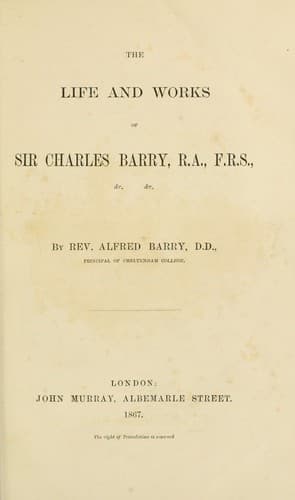
The life and works of Sir Charles BarryBarry, Alfred
General
The life and works of Sir Charles Barry
Barry, Alfred
Architects -- Great Britain -- Biography; Barry, Charles, 1795-1860
The first was the desire to increase as much as possible the upward
tendency of the lines of the design, to elevate and vary the skyline
throughout. Every ventilating shaft was taken advantage of; every turret
was heightened, till the central lantern, itself an insertion, was
surrounded by a forest of louvres and spires. The whole character of the
design was changed; and the change arose, partly from original
predilection for the spire form, partly from advancing knowledge of
Gothic architecture, but principally from practical experience of the
great architectural disadvantages entailed by the site, and the
comparative lowness of the building itself. The change has been
generally recognised as an improvement.
The other tendency was to profuse ornamentation. His notion was that a
general spread of minute ornament, a kind of “diapering” of the whole,
was rich, but more simple, because less likely to interfere with the
main outline, than ornaments on a large scale more sparingly employed.
In the particular case before him he thought that smallness of scale in
details would help to give an appearance of size to the building. But
his feeling always was that ornamentation, if right in kind, could not
be overdone; he did not recognise the value of plainer portions to act
as a “setting” of the decoration; to him they appeared as “neglected
spots;” and partiality of ornament he considered as tawdriness. In the
internal courts he carried plainness out, even to excess; but he would
not unite the two principles.
The effect was visible over the fronts of the whole building, the more
so, because his great idea was, by the aid of the sister arts, to make
the New Palace a monumental history of England. Sculpture without,
sculpture, painting, and stained glass within, were to preserve the
memorials of the past, and declare the date and object of the
building.[102]
Nothing provoked more criticism than this high ornamentation of the
design; but, in spite of all such adverse criticism, he still held to
the principle as the true one, and believed that it would eventually be
recognised as such. It was once remarked by M. Guizot that the work was
a “mélange de finesse et de grandeur.” Such was certainly the leading
idea which inspired its design.
II. The preceding section has described the principles which governed
the original conception and subsequent modifications of this great
design. It remains only to give a brief description of the building as
it exists, so far as is necessary to serve as a guide to the annexed
plan.[103]
Public-domain text, read in full here on John Shaqi.
Reviews
Reviews
No reviews yet
Be the first to share your thoughts on this work.
Elsewhere in the archive
Join the Discussion
Join the discussion
Sign in to leave a comment or review.
Sign InorCreate an account