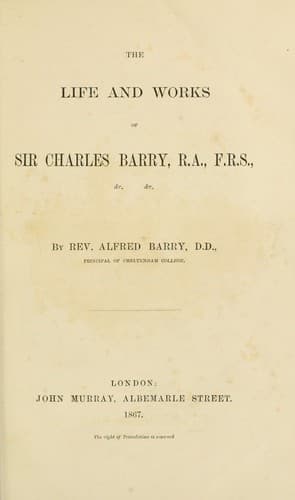
The life and works of Sir Charles BarryBarry, Alfred
General
The life and works of Sir Charles Barry
Barry, Alfred
Architects -- Great Britain -- Biography; Barry, Charles, 1795-1860
The tower was at first intended to contain such of the public records as
were not frequently in use, and was arranged accordingly with two lofty
internal stories. Subsequently orders were given to accommodate all the
records; not without great inconvenience, but with much ingenuity,
accommodation was provided by the insertion of numerous floors and other
contrivances. After all, the intention was abandoned by the authorities,
and all the trouble and expense were thrown away.
The clock-tower was the one feature of the building which gave the
greatest trouble, and for which design after design was made and
rejected. It was to be what its name implied: the clock was to be the
one prominent feature, not a mere accessory--treated as an architectural
ornament. For practical purposes it was to be raised on the highest
story, and made of immense size; the ornamental character of the whole
front required that the lower part of the tower should be faced with
delicate panelling, and yet a “top-heavy” effect must be carefully
avoided. It was at once decided that the lower part should be solid,
with but slight openings. To make the clock-story duly prominent all
sorts of devices were thought of, till at last an example was remembered
in which the whole clock-story was made to project beyond the body of
the tower. The suggestion was eagerly caught at; the example quoted
differed in almost every respect from the character of the tower to be
designed, and endless modifications were needed; but the general
principle was preserved, and the result is one of the most striking
features of the building. Still the termination remained; designs and
models were tried over and over again; some forms appeared deficient in
lightness, others were rejected as too ecclesiastical; till at last the
form was devised which we now see. On the whole he felt satisfied with
the tower, only thinking that the outline would have been improved by
raising both the bell-chamber and the terminal portion of the roof, and
regretting the angular projections on the face of the turrets below,
which are terminated abruptly by the clock-story afterwards devised. His
work on this and the Victoria tower gives a striking specimen of the
process by which the whole design was worked out; no labour, no delay,
no expense, seemed excessive in the pursuit of what he thought
perfection, even in the minutest detail. They were temporary; the
censures they might provoke were also temporary; the result was lasting,
and worth any temporary sacrifice.[101]
Such were the reasons which led to modifications of the original design
in the chief portions of the building. Besides these, however, two
general tendencies must be noticed.
Public-domain text, read in full here on John Shaqi.
Reviews
Reviews
No reviews yet
Be the first to share your thoughts on this work.
Elsewhere in the archive
Join the Discussion
Join the discussion
Sign in to leave a comment or review.
Sign InorCreate an account