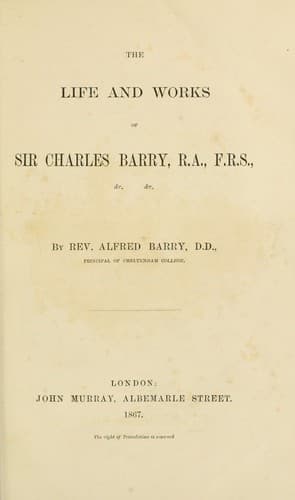
The life and works of Sir Charles BarryBarry, Alfred
General
The life and works of Sir Charles Barry
Barry, Alfred
Architects -- Great Britain -- Biography; Barry, Charles, 1795-1860
To the latter course Sir Charles was strongly opposed. There could be
nothing to recommend it, except the notion that it would give a better
architectural effect (for there is already open space close at hand,
fully sufficient for sanitary requirements). But this notion appeared to
him utterly erroneous. By leaving New Palace Yard open, or enclosing it
only by a railing, the buildings surrounding it (Westminster Hall and
the rest) are viewed from the higher ground of Bridge Street, and appear
actually sunk, while the area itself, having a considerable diagonal
fall across the open space, is singularly unfortunate in its effect. By
pulling down the Law Courts, and opening the whole side of Westminster
Hall, he conceived that a still worse effect would be produced; for the
scale and parts of the Hall are so large, that it must be utterly
incongruous with the buildings round it. He conceived therefore that
this proposal to leave the space unoccupied would be detrimental
architecturally, while in an economic and practical point of view it
would be an unwarrantable waste.
Accordingly his proposal[115] was to erect a line of building, occupying
the site of the Law Courts and the western and northern sides of New
Palace Yard, giving ample and even liberal accommodation for all public
needs. New Palace Yard was to be entered on its west side by a grand
gate-tower, or triple archway flanked by towers, leading by a gentle and
uniform slope (about 1 in 50) to the present entrances, which, having
been always intended as archways for an interior court, have not
sufficient dignity or importance for the chief public entrances to the
building. On the south side, Westminster Hall would form a grand centre
with a range of buildings on each side of it; and on the north side, if
a high range of buildings were thought objectionable, a cloister with
one story above it, or an open arcade, might mask the building from the
high ground of Bridge Street. The great entrance gate-tower he had
proposed to call the Albert Tower, in a kind of correspondence with the
Victoria Tower, which is the great royal entrance, serving like it to
mark the date of the building, and to commemorate the lively interest
which the late Prince Consort took in all that concerned its artistic
decoration.
Public-domain text, read in full here on John Shaqi.
Reviews
Reviews
No reviews yet
Be the first to share your thoughts on this work.
Elsewhere in the archive
Join the Discussion
Join the discussion
Sign in to leave a comment or review.
Sign InorCreate an account