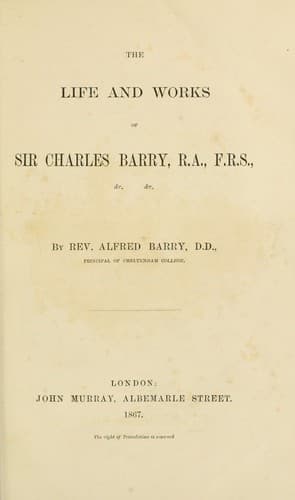
The life and works of Sir Charles BarryBarry, Alfred
General
The life and works of Sir Charles Barry
Barry, Alfred
Architects -- Great Britain -- Biography; Barry, Charles, 1795-1860
On the occasion of the Emperor of Russia’s visit to England, he visited
the New Palace under the guidance of the architect, and requested that
drawings of its chief elevations might be furnished to him. These were
acknowledged in handsome terms, and the acknowledgment was accompanied
by a present of the drawings of the Winter Palace at St. Petersburg, and
one of those magnificent diamond snuff-boxes which seem to be the
established gifts of royalty.
There were indeed few foreign visitors, distinguished either for rank or
for artistic eminence, who did not visit and admire his great work, and
the _éloge_ of M. Hittorf, read at the meeting of the Five Academies of
Paris on August 14th, 1860 (making all allowance for the time and
occasion), may be taken as not unfairly representing the general feeling
of continental artists.[117]
PROFESSIONAL ARBITRATIONS.--Besides the exercise of influence in public
commissions and institutions, an architect who has attained a high rank
in his profession, especially at a time when he is beginning to
relinquish active work, has an important sphere of exertion in respect
of professional arbitrations.
Open competitions are, and long have been, the order of the day. In the
decision of the prize much of the dissatisfaction often caused, and the
practical injustice often done, arises, not from any partiality or want
of ability in the judges, but from the want of practical knowledge of
detail, or of the advice of a practical assessor. There are drawbacks to
the value of a professional arbitrator; certainly much difficulty and
odium attach to his position. But to see the way through a complicated
plan, to judge how an attractive elevation will work out, and how far an
estimate can possibly be kept to, must certainly require the aid of
professional knowledge.
Accordingly, in the latter part of his career, Sir Charles Barry was
not unfrequently employed as professional arbiter in public
competitions.
In 1845 he was appointed to adjudge the first place in the competition
for the Free Church College in Edinburgh--a building which was to occupy
one of the finest sites in the city. He bestowed great pains on the
adjudication, and gave some suggestions for the improvement of the
design. But the award was practically set aside, and the present
building erected, from a design for which he was not responsible.
In 1847 he was again employed to examine and report on the drawings of
the competitors for the erection of the Glasgow College.
Public-domain text, read in full here on John Shaqi.
Reviews
Reviews
No reviews yet
Be the first to share your thoughts on this work.
Elsewhere in the archive
Join the Discussion
Join the discussion
Sign in to leave a comment or review.
Sign InorCreate an account