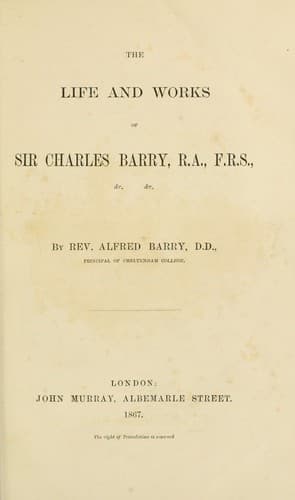
The life and works of Sir Charles BarryBarry, Alfred
General
The life and works of Sir Charles Barry
Barry, Alfred
Architects -- Great Britain -- Biography; Barry, Charles, 1795-1860
In December 1852 the Town Council of Leeds requested him to undertake
the office of professional arbiter in the competition for the erection
of their Town Hall. He went into the matter with his usual care and
energy, and satisfied himself that the design of Mr. Brodrick, then
comparatively a young man, was decidedly the best. On this occasion he
had to meet some considerable efforts of local interest in behalf of
other competitors; and at one time thought, that he might be obliged to
throw up his office, and publish the correspondence. But he stood firm
in what he considered to be his duty, and succeeded in securing the
erection of a building, which has been since very generally admired.
On all such occasions he showed remarkably his characteristic power of
throwing himself, heart and soul, into the work before him. On the
process of forming his judgment he bestowed infinite pains, and usually
spent some considerable time. But his judgments, when formed, were
usually positive and decisive, inclining perhaps occasionally to
consider the capacities of a design, more than the standard of its
performance, and valuing imperfect promise more highly than finished
mediocrity. This is a tendency, which doubtless may be pushed even to
the verge of injustice. Still it must be considered as that which has on
the whole, more than any other, the double merit of rewarding real
talent, and of securing men, who are capable of carrying out and
perfecting, in the process of their accomplishment, buildings of real
artistic excellence. It is almost needless to add, that he maintained
his judgments unflinchingly, and defied all influences which tended to
interfere with their independence and effectiveness.
ST. PAUL’S COMMITTEE.--In 1858 Sir Charles was placed upon the Committee
for administering the St. Paul’s Cathedral Fund, a fund raised to assist
the Dean and Chapter, first, in the maintenance of the Special Evening
Services, and next in carrying out, if possible, some worthy system of
decoration of the Cathedral. He took the warmest interest in the work.
Admiring, as he did, enthusiastically the genius of Sir C. Wren, he felt
it a privilege to contribute in the slightest degree to the
embellishment of his great work, and its adaptation to the needs of our
own time. Here, as in other cases, his only difficulty was to persuade
himself to rest contented with that which was immediately practicable,
instead of stretching on towards the ideal conceived in his own mind.
To some of the changes actually made he gave in consequence but a
doubtful acquiescence.
Public-domain text, read in full here on John Shaqi.
Reviews
Reviews
No reviews yet
Be the first to share your thoughts on this work.
Elsewhere in the archive
Join the Discussion
Join the discussion
Sign in to leave a comment or review.
Sign InorCreate an account