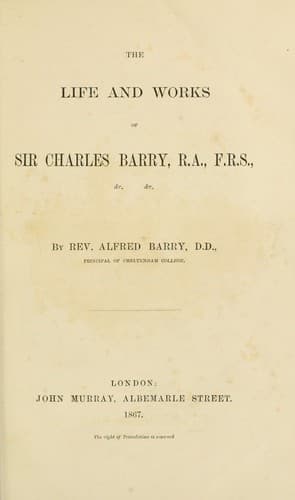
The life and works of Sir Charles BarryBarry, Alfred
General
The life and works of Sir Charles Barry
Barry, Alfred
Architects -- Great Britain -- Biography; Barry, Charles, 1795-1860
By this temperament, naturally buoyant and elastic, by the power of a
disposition warm-hearted and capable of enthusiasm, by his remarkable
determination of will, when once his mind was made up, and by the fact
that, before he had come to a determination, he was singularly open to
suggestion, by the resolution never to put up, even in little things,
with what was defective or erroneous, he mostly prevailed. Clients,
colleagues, even superiors, generally let him have his own way; for they
felt that his determination was at least conscientious and
disinterested. In his professional work especially, although he made
mistakes and miscalculations, which might cause hardship, and sometimes,
it may be, practical injustice, his determination was sustained by an
integrity above all suspicion. Architects and engineers, dealing with
large sums, the expenditure of which they alone are able to control or
criticize, are frequently exposed to solicitation, and even temptation,
to relax vigilance and show personal favour at the expense of justice.
Even a high rank in the profession does not secure men against the
exertion of this influence, and few young beginners are spared the
experience of it. It is well that, especially at the present time, the
profession at large stands strong in known integrity, though the
exercise of the vigilance and determination, which it requires, is often
a thankless work. Of that integrity Sir Charles Barry did his duty in
setting an example. Though he had many enemies, none even ventured on a
breath of slander in this respect.
That he was ambitious cannot be questioned. There are two kinds of
ambition; there is the desire of glory in itself, which seems to be its
lower form; we find a higher ambition in the desire of doing something,
which is not unworthy of glory, whether it obtains it or not. I think he
felt both strongly. For praise and reputation are the chief secondary
rewards of an artistic life, the compensation for foregoing the more
material returns, which can be best obtained in other walks of life. But
he lived long enough to feel, what all experience of life teaches, the
capricious manner in which such reward is bestowed, and the
insufficiency of it, even when it is obtained in the fullest measure. At
no time would he have sacrificed to it the higher ambition of doing that
which was artistically the best, though it might draw down a storm of
unpopularity and censure. Whenever the lower ambition is thus clearly
subordinated, it must be regarded as an instinct of humanity, capable
of giving force and life to the character, without the excitability and
selfishness which mark its exclusive predominance.
Public-domain text, read in full here on John Shaqi.
Reviews
Reviews
No reviews yet
Be the first to share your thoughts on this work.
Elsewhere in the archive
Join the Discussion
Join the discussion
Sign in to leave a comment or review.
Sign InorCreate an account