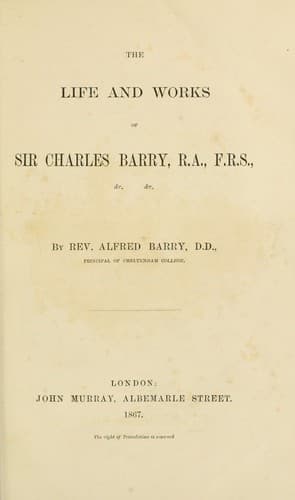
The life and works of Sir Charles BarryBarry, Alfred
General
The life and works of Sir Charles Barry
Barry, Alfred
Architects -- Great Britain -- Biography; Barry, Charles, 1795-1860
The same union of balancing elements of character was seen in regard of
external influence upon him. His mind was certainly original, and his
resolution and will most determined. Yet to external influences, direct
and indirect, even to the tone of feeling and character of those who
were with him, he was as certainly sensitive. Suggestion or criticism,
warning or encouragement, he readily, almost unconsciously, took in, and
seemed to assimilate, till they formed a part of his own mind. In
respect of his own art, however, this susceptibility to external
influence produced no inconsistency, for its results were fused under
the power of his original conception, and therefore, while they
prevented anything fantastic and whimsical, they did not weaken the
vigour which belongs to self-reliance. In fact it was one of the causes
of that progressiveness of mind, which was always remarked in him, and
to which allusion has already been made. He had a firm grasp of certain
great principles; therefore he had the power to appreciate and to
assimilate knowledge, from whatever sources it came. He was fettered by
no system of rules; therefore he had the elasticity of mind, without
which it is impossible to profit by external influence and teaching. To
the last he confessed himself a learner. Sometimes, indeed, he would
take up some new idea suggested from without, with characteristic
eagerness, and begin to develope from it inferences, which were to yield
a new store of first principles. But when these first principles were
carefully scanned, they were found to be “old friends under a new face;”
and so the new modification was accepted, while the essential ideas
remained substantially the same. His works, accordingly, though they
showed progressiveness, were always characteristic, and had a certain
unity, which no competent eye can fail to discern.
Much indeed of his success and his power of influence depended on this
union of apparently opposite elements, on this absence of one-sidedness
and distortion of character. It was not produced in him by the deepening
and enlarging influence of abstract study. Even in his own art his
knowledge was gained mainly by experience, and he studied best with the
pencil in his hand. But in other fields of thought, he had in him very
little of the student. His interest indeed was wide and keen enough, but
it showed itself in quickness of observation and intuition, rather than
in any profound study. Even from politics he to a great extent stood
aloof, though he was consistently attached to the Liberal party, and his
mind was certainly more innovating than conservative. Science (as has
been said) interested him far more than literature. Had he not been
distinguished as an artist, he might well have made himself a name in
mechanical science, in which his great fertility of contrivance, his
love of enterprise, and his tendency to set aside stereotyped systems
and conventional rules, would have found a congenial field of exercise.
Public-domain text, read in full here on John Shaqi.
Reviews
Reviews
No reviews yet
Be the first to share your thoughts on this work.
Elsewhere in the archive
Join the Discussion
Join the discussion
Sign in to leave a comment or review.
Sign InorCreate an account