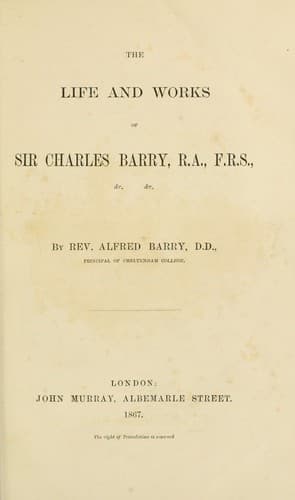
The life and works of Sir Charles BarryBarry, Alfred
General
The life and works of Sir Charles Barry
Barry, Alfred
Architects -- Great Britain -- Biography; Barry, Charles, 1795-1860
The end came most suddenly and unexpectedly. He had suffered for some
time from a cough, which no remedy appeared to touch, but which
nevertheless was thought to present no appearance of danger. On the 12th
of May, 1860, he had been with Lady Barry to spend the afternoon at the
Crystal Palace, and had seemed very calm and cheerful, speaking of the
natural dispersion of their children, and of the end of life, in which
they should be thrown upon each other, as at its beginning. The evening
had been spent as usual, and at the regular time, about eleven o’clock,
he had retired to his dressing-room. There he was seized with difficulty
of breathing and pain; and, before any of his children could be
summoned, almost before it was known that there was imminent danger, all
was over. It was found afterwards that the cause of death was a weakness
of action both in the lungs and in the heart. Death might have come
suddenly at any moment. That he had felt some vague presentiment of it
was shown by his having put his affairs in order early in the year. But
it is doubtful whether he was conscious of its actual approach. It was a
cause of thankfulness for his sake that it came so painlessly, and that,
though his children, to their great grief, were absent, his wife was
with him to the end.
It had been intended by his family that his funeral should be private,
conducted in accordance with the privacy and simplicity of his life. But
almost immediately the chief members of his profession expressed a wish
that his body should be laid in Westminster Abbey, among the
“representative men” of the country. The idea was readily taken up,
especially in the Institute of British Architects. A deputation from
that body waited on the Dean, who willingly accorded the needful
permission, and it was settled that his body should be laid in the nave.
It was but recently that Literature had been so honoured in the person
of Lord Macaulay, and Science in the person of Robert Stephenson. Close
by the side of the latter the new grave was opened.
The funeral took place on May 22nd (the day before his sixty-fifth
birth-day). The family procession, moving from Clapham, was met at
Vauxhall Bridge by the carriages containing the members of the Institute
and other distinguished persons, and by a large body of workmen engaged
in his works at the New Palace and elsewhere, who had requested
permission to follow him to the grave. So augmented, it moved on to the
Abbey.
Public-domain text, read in full here on John Shaqi.
Reviews
Reviews
No reviews yet
Be the first to share your thoughts on this work.
Elsewhere in the archive
Join the Discussion
Join the discussion
Sign in to leave a comment or review.
Sign InorCreate an account