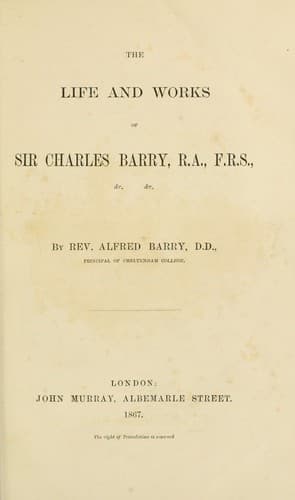
The life and works of Sir Charles BarryBarry, Alfred
General
The life and works of Sir Charles Barry
Barry, Alfred
Architects -- Great Britain -- Biography; Barry, Charles, 1795-1860
“All the gentlemen who were to take part in the procession, and who
numbered between 400 and 500 representatives of the great societies of
arts and science in England, assembled in places adjoining the
cloisters, and there awaited the arrival of the funeral _cortége_. The
hearse reached Dean’s-yard a few minutes before 1 o’clock, and the
coffin was borne through the old cloisters to the side entrance of the
nave, where the Dean and Chapter, headed by the choir, were waiting. The
procession was then formed, and to Purcell’s solemn anthem, ‘I am the
resurrection and the life,’ moved slowly up the nave. First came the
High Bailiff of Westminster, then the beadsmen, vergers, and choir,
followed by the Dean and Chapter, and the coffin. There were eight
pall-bearers--Sir Charles Eastlake, President of the Royal Academy; the
Chief Commissioner of Works, the Right Hon. W. Cowper, M.P.; Mr. G. P.
Bidder, President of the Institute of Civil Engineers;
Lieutenant-General Sir E. Cust; the President of the Architectural
Museum, Mr. A. J. Beresford Hope; the Dean of St. Paul’s; the President
of the Royal Institute of British Architects, Mr. C. R. Cockerell; and
Mr. Tite, F.R.S., M.P. Immediately following the body the five sons of
the deceased walked as chief mourners, with the Dean of Chichester and
other private friends of the late Sir Charles. To these succeeded a
procession of immense length, which took nearly a quarter of an hour to
file slowly into the Abbey, and for the members of which there was
scarcely sufficient accommodation either in the choir or in the nave.
The House of Commons was represented by Lord John Manners, Mr. J.
Greene, Mr. R. S. Gard, Sir Joseph Paxton, Sir S. M. Peto, Sir A. Hood,
Mr. F. V. Hume, and Mr. J. Locke. Among the Council and members of the
Royal Academy were Messrs. T. Creswick, A. Elmore, J. H. Foley, S. A.
Hart, J. R. Herbert, G. Jones, J. P. Knight, Sir E. Landseer, Messrs. C.
Landseer, D. Maclise, P. Macdonall, W. C. Marshall, B. W. Pickersgill,
F. R. Pickersgill, J. Phillip, D. Roberts, R. Redgrave, C. Stansfield,
S. Smirke, R. Westmacott, and Professor Partridge. Among the associates
were also Messrs. T. L. Cooper, W. Frost, P. F. Poole, E. W. Cooke, F.
Goodall, G. G. Scott, B. O’Neil, R. G. Lane, and J. T. Willmore. Of the
Council and members of the Royal Society there were the Rev. J. Barlow,
Sir Roderick Murchison, Messrs. J. P. Guest, C. R. Weld, J. P. Gassiott,
and R. W. Walton. The Council of the Institute of Civil Engineers was
represented by Messrs. C. H. Gregory, T. Hawksley, J. Locke, M.P., Sir
J. Rennie, F.R.S., Messrs. J. Simpson, C. Manby, F.R.S., T. H. Wyatt, J.
Hawkshaw, F.R.S., J. R. Maclean, J. Cubitt, J. E. Errington, J. E.
Harrison, J. D. Hemans, J. Murray, &c.; and the Council of the
Architectural Museum by Messrs. E. Street, J. Clarke, R. Brandon, E.
Christian, Rev. T. Scott, Messrs. G. Scharf, H. D. Chantrell, W. Slater,
and J. Gibson. Of the Council and members of the Institute of British
Public-domain text, read in full here on John Shaqi.
Reviews
Reviews
No reviews yet
Be the first to share your thoughts on this work.
Elsewhere in the archive
Join the Discussion
Join the discussion
Sign in to leave a comment or review.
Sign InorCreate an account