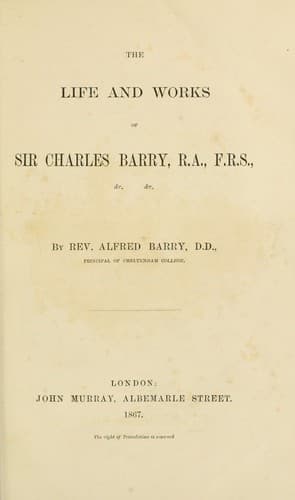
The life and works of Sir Charles BarryBarry, Alfred
General
The life and works of Sir Charles Barry
Barry, Alfred
Architects -- Great Britain -- Biography; Barry, Charles, 1795-1860
But even now the triumph was not without alloy. Professional jealousy
did not sleep. Perhaps it was inevitable that some soreness should be
felt by the unsuccessful competitors for so important a work. It was
certainly natural that sharp criticisms should be pronounced on the
selected design. But happily few architects have had to encounter such a
clamour as was then raised,--a clamour which certainly passed beyond the
legitimate province of artistic criticism, venturing to attack the
competency and honesty of the judges, and the private character of the
successful architect.
In the first instance the partisans of classical architecture raised
their voices in a somewhat tardy protest against the adoption of the
Gothic style. They felt it to be a death-blow to the supremacy which
Greek and Roman architecture had hitherto enjoyed. An article in the
‘London and Westminster Review,’ by “B.,” stigmatized Gothic as “a mere
‘ecclesiastical style,’” and advocated a change of site, as a less evil
than the local necessity for the adoption of obnoxious Gothicism. W. R.
Hamilton’s “Letters to the Earl of Elgin” embodied, in an abler and more
elaborate dissertation, the same protest against that which the writer
conceived to be an antique and venerable barbarism. The rising Gothic
school, of course, would not suffer such artistic blasphemy to pass
unnoticed. Col. Jackson, in answer to Mr. Hamilton, took a defensive
line, denying a monopoly of beauty to Classical architecture, and
putting forward for Gothic the plea of nationality, of picturesque or
romantic beauty, and of local associations. But this tone did not
content Mr. Pugin; he followed with an article in favour of Gothic,
breathing a little of the more aggressive spirit of the present Gothic
school. He himself had not appeared among the competitors, although one
set of designs was believed to have emanated in great degree from
him.[65] It will be obvious to any one who knows his designs or
writings, that he must greatly have disapproved of many main principles
in Mr. Barry’s designs. But the question at issue was the dignity and
value of Gothic architecture generally, and he plunged into it with all
the enthusiasm of his character.
All this controversy was natural and justifiable; the only objection to
the plea of the Classicists was that it came too late, and the whole is
interesting, chiefly as marking the important influence which this
competition was felt to exercise on the progress of Gothic architecture
in this country.
Public-domain text, read in full here on John Shaqi.
Reviews
Reviews
No reviews yet
Be the first to share your thoughts on this work.
Elsewhere in the archive
Join the Discussion
Join the discussion
Sign in to leave a comment or review.
Sign InorCreate an account