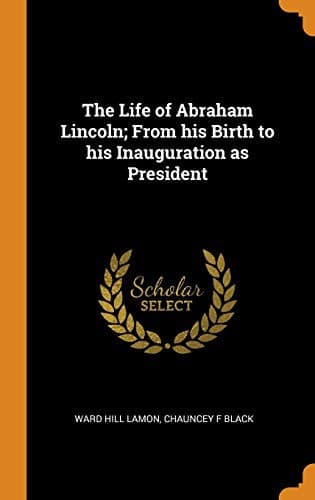
The Life of Abraham Lincoln, from His Birth to His Inauguration as PresidentLamon, Ward Hill
History
The Life of Abraham Lincoln, from His Birth to His Inauguration as President
Lamon, Ward Hill
Lincoln, Abraham, 1809-1865
Upon the subject of education, not presuming to dictate any plan
or system respecting it, I can only say that I view it as the most
important subject which we as a people can be engaged in. That every
man may receive at least a moderate education, and thereby be enabled to
read the histories of his own and other countries, by which he may duly
appreciate the value of our free institutions, appears to be an object
of vital importance, even on this account alone, to say nothing of the
advantages and satisfaction to be derived from all being able to read
the Scriptures and other works, both of a religious and moral nature,
for themselves.
For my part, I desire to see the time when education--and, by its means,
morality, sobriety, enterprise, and industry--shall become much more
general than at present, and should be gratified to have it in my power
to contribute something to the advancement of any measure which might
have a tendency to accelerate the happy period.
With regard to existing laws, some alterations are thought to be
necessary. Many respectable men have suggested that our estray laws--the
law respecting the issuing of executions, the road-law, and some
others--are deficient in their present form, and require alterations.
But, considering the great probability that the framers of those laws
were wiser than myself, I should prefer not meddling with them, unless
they were first attacked by others; in which case I should feel it both
a privilege and a duty to take that stand, which, in my view, might tend
most to the advancement of justice.
But, fellow-citizens, I shall conclude. Considering the great degree of
modesty which should always attend youth, it is probable I have already
been more presuming than becomes me. However, upon the subjects of
which I have treated, I have spoken as I have thought. I may be wrong in
regard to any or all of them; but, holding it a sound maxim, that it is
better only sometimes to be right than at all times wrong, so soon as I
discover my opinions to be erroneous, I shall be ready to renounce them.
Every man is said to have his peculiar ambition. Whether it be true or
not, I can say, for one, that I have no other so great as that of being
truly esteemed of my fellow-men, by rendering myself worthy of their
esteem. How far I shall succeed in gratifying this ambition is yet to be
developed. I am young, and unknown to many of you. I was born, and have
ever remained, in the most humble walks of life. I have no wealthy or
popular relations or friends to recommend. My case is thrown exclusively
upon the independent voters of the county; and, if elected, they will
have conferred a favor upon me, for which I shall be unremitting in my
labors to compensate. But, if the good people in their wisdom shall
see fit to keep me in the background, I have been too familiar with
disappointments to be very much chagrined.
Your Friend and Fellow-Citizen,
A. LINCOLN.
New Salem, March 9, 1832.
Public-domain text, read in full here on John Shaqi.
Reviews
Reviews
No reviews yet
Be the first to share your thoughts on this work.
Elsewhere in the archive
Join the Discussion
Join the discussion
Sign in to leave a comment or review.
Sign InorCreate an account