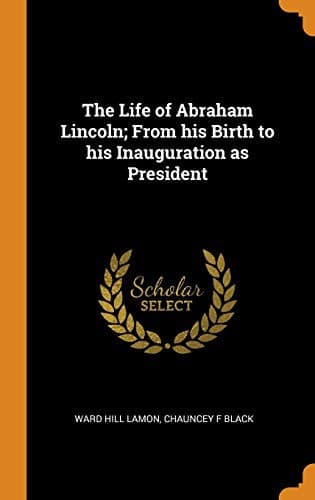
The Life of Abraham Lincoln, from His Birth to His Inauguration as PresidentLamon, Ward Hill
History
The Life of Abraham Lincoln, from His Birth to His Inauguration as President
Lamon, Ward Hill
Lincoln, Abraham, 1809-1865
This vote has nothing to do in determining my votes on the questions of
supplies. I have always intended, and still intend, to vote supplies;
perhaps not in the precise form recommended by the President, but in a
better form for all purposes, except Locofoco party purposes. It is
in this particular you seem mistaken. The Locos are untiring in their
efforts to make the impression that all who vote supplies, or take part
in the war, do, of necessity, approve the President's conduct in the
beginning of it; but the Whigs have, from the beginning, made and kept
the distinction between the two. In the very first act nearly all the
Whigs voted against the preamble declaring that war existed by the act
of Mexico; and yet nearly all of them voted for the supplies. As to the
Whig men who have participated in the war, so far as they have spoken to
my hearing, they do not hesitate to denounce as unjust the President's
conduct in the beginning of the war. They do not suppose that such
denunciation is directed by undying hatred to them, as "The Register"
would have it believed. There are two such Whigs on this floor (Col.
Haskell and Major James). The former fought as a colonel by the side of
Col. Baker, at Cerro Gordo, and stands side by side with me in the
vote that you seem dissatisfied with. The latter, the history of whose
capture with Cassius Clay you well know, had not arrived here when that
vote was given; but, as I understand, he stands ready to give just such
a vote whenever an occasion shall present. Baker, too, who is now here,
says the truth is undoubtedly that way; and, whenever he shall speak
out, he will say so. Col. Donaphin, too, the favorite Whig of Missouri,
and who overrun all Northern Mexico, on his return home, in a public
speech at St. Louis, condemned the administration in relation to the
war, if I remember. G. T. M. Davis, who has been through almost the
whole war, declares in favor of Mr. Clay; from which I infer that he
adopts the sentiments of Mr. Clay, generally at least. On the other
hand, I have heard of but one Whig who has been to the war attempting
to justify the President's conduct. That one was Capt. Bishop; editor of
"The Charleston Courier," and a very clever fellow. I do not mean this
letter for the public, but for you. Before it reaches you, you will have
seen and read my pamphlet speech, and, perhaps, scared anew by it. After
you get over your scare, read it over again, sentence by sentence, and
tell me honestly what you think of it. I condensed all I could for fear
of being cut off by the hour rule; and, when I got through, I had spoken
but forty-five minutes. Yours forever,
A. Lincoln.
Washington, Feb. 15, 1848.
Public-domain text, read in full here on John Shaqi.
Reviews
Reviews
No reviews yet
Be the first to share your thoughts on this work.
Elsewhere in the archive
Join the Discussion
Join the discussion
Sign in to leave a comment or review.
Sign InorCreate an account