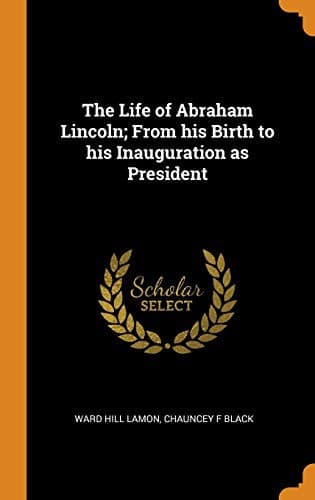
The Life of Abraham Lincoln, from His Birth to His Inauguration as PresidentLamon, Ward Hill
History
The Life of Abraham Lincoln, from His Birth to His Inauguration as President
Lamon, Ward Hill
Lincoln, Abraham, 1809-1865
Dear William,--Your letter of the 29th January was received last night.
Being exclusively a constitutional argument, I wish to submit some
reflections upon it in the same spirit of kindness that I know actuates
you. Let me first state what I understand to be your position. It is,
that, if it shall become necessary _to repel invasion_, the President
may, without violation of the Constitution, cross the line, and _invade_
the territory of another country; and that whether such _necessity_
exists in any given case, the President is the _sole_ judge.
Before going farther, consider well whether this is, or is not, your
position. If it is, it is a position that neither the President himself,
nor any friend of his, so far as I know, has ever taken. Their only
positions are, first, that the soil was ours where the hostilities
commenced; and second, that, whether it was rightfully ours or not,
Congress had annexed it, and the President, for that reason, was bound
to defend it, both of which are as clearly proved to be false in fact
as you can prove that your house is mine. That soil was not ours; and
Congress did not annex, or attempt to annex it. But to return to your
position. Allow the President to invade a neighboring nation whenever he
shall deem it necessary to repel an invasion, and you allow him to do so
_whenever he may choose to say_ he deems it necessary for such purpose,
and you allow him to make war at pleasure. Study to see if you can fix
_any limit_ to his power in this respect, after having given him so much
as you propose. If to-day he should choose to say he thinks it necessary
to invade Canada, to prevent the British from invading us, how could
you stop him? You may say to him, "I see no probability of the British
invading us;" but he will say to you, "Be silent: I see it, if you
don't."
The provision of the Constitution giving the war-making power to
Congress was dictated, as I understand it, by the following reasons:
kings had always been involving and impoverishing their people in wars,
pretending generally, if not always, that the good of the people was the
object. This our convention understood to be the most oppressive of all
kingly oppressions; and they resolved to so frame the Constitution that
_no one man_ should hold the power of bringing this oppression upon us.
But your view destroys the whole matter, and places our President where
kings have always stood.
Write soon again.
Yours truly,
A. Lincoln.
But the Whig National Convention to nominate a candidate for the
Presidency was to meet at Philadelphia on the 1st of June, and Mr.
Lincoln was to be a member. He was not a Clay man: he wanted a candidate
that could be elected; and he was for "Old Rough," as the only available
material at hand. But let him explain himself:--
Washington, April 30, 1848.
Public-domain text, read in full here on John Shaqi.
Reviews
Reviews
No reviews yet
Be the first to share your thoughts on this work.
Elsewhere in the archive
Join the Discussion
Join the discussion
Sign in to leave a comment or review.
Sign InorCreate an account