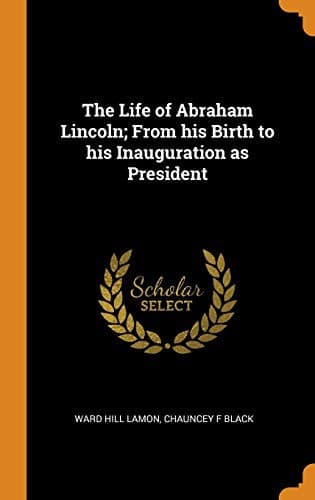
The Life of Abraham Lincoln, from His Birth to His Inauguration as PresidentLamon, Ward Hill
History
The Life of Abraham Lincoln, from His Birth to His Inauguration as President
Lamon, Ward Hill
Lincoln, Abraham, 1809-1865
plausible, is a most pernicious deception. By means of it, measures are
adopted or rejected contrary to the wishes of the whole of one party,
and often nearly half of the other. The process is this: Three, four, or
half a dozen questions are prominent at a given time; the party selects
its candidate, and he takes his position on each of these questions.
On all but one his positions have already been indorsed at former
elections, and his party fully committed to them; but that one is new,
and a large portion of them are against it. But what are they to do? The
whole are strung together, and they must take all or reject all. They
cannot take what they like, and leave the rest. What they are already
committed to being the majority, they shut their eyes and gulp the
whole. Next election, still another is introduced in the same way. If
we run our eyes along the line of the past, we shall see that almost, if
not quite, all the articles of the present Democratic creed have been at
first forced upon the party in this very way. And just now, and just so,
opposition to internal improvements is to be established if Gen. Cass
shall be elected. Almost half the Democrats here are for improvements,
but they will vote for Cass; and, if he succeeds, their votes will have
aided in closing the doors against improvements. Now, this is a process
which we think is wrong. We prefer a candidate, who, like Gen. Taylor,
will allow the people to have their own way, regardless of his private
opinion; and I should think the internal-improvement Democrats, at
least, ought to prefer such a candidate. He would force nothing on them
which they don't want; and he would allow them to have improvements
which their own candidate, if elected, will not.
Mr. Speaker, I have said Gen. Taylor's position is as well defined as is
that of Gen. Cass. In saying this, I admit I do not certainly know what
he would do on the Wilmot Proviso. I am a Northern man, or, rather, a
Western Free State man, with a constituency I believe to be, and with
personal feelings I know to be, against the extension of slavery.
As such, and with what information I have, I hope and _believe_ Gen.
Taylor, if elected, would not veto the proviso; but I do not _know_ it.
Yet, if I knew he would, I still would vote for him. I should do so,
because, in my judgment, his election alone can defeat Gen. Cass; and
because, _should_ slavery thereby go into the territory we now have,
just so much will certainly happen by the election of Cass, and, in
addition, a course of policy leading to new wars, new acquisitions of
territory, and still farther extensions of slavery. One of the two is to
be President; which is preferable?
Public-domain text, read in full here on John Shaqi.
Reviews
Reviews
No reviews yet
Be the first to share your thoughts on this work.
Elsewhere in the archive
Join the Discussion
Join the discussion
Sign in to leave a comment or review.
Sign InorCreate an account