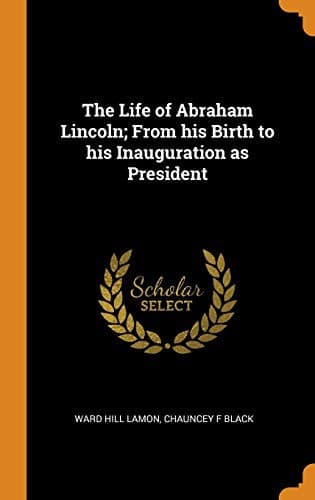
The Life of Abraham Lincoln, from His Birth to His Inauguration as PresidentLamon, Ward Hill
History
The Life of Abraham Lincoln, from His Birth to His Inauguration as President
Lamon, Ward Hill
Lincoln, Abraham, 1809-1865
One word more, and I shall have done with this branch of the subject.
You Democrats and your candidate, in the main, are in favor of laying
down in advance a platform,--a set of party positions, as a unit; and
then of enforcing the people, by every sort of appliance, to ratify
them, however unpalatable some of them may be. We and our candidate are
in favor of making Presidential elections and the legislation of the
country distinct matters; so that the people can elect whom they please,
and afterward legislate just as they please, without any hinderance,
save only so much as may guard against infractions of the Constitution,
undue haste, and want of consideration. The difference between us is
clear as noonday. That we are right, we cannot doubt. We hold the true
republican position. In leaving the people's business in their hands, we
cannot be wrong. We are willing, and even anxious, to go to the people
on this issue.
But I suppose I cannot reasonably hope to convince you that we have any
principles. The most I can expect is, to assure you that we think we
have, and are quite contented with them. The other day, one of the
gentlemen from Georgia (Mr. Iverson), an eloquent man, and a man of
learning, so far as I can judge, not being learned myself, came down
upon us astonishingly. He spoke in what "The Baltimore American" calls
the "scathing and withering style." At the end of his second severe
flash I was struck blind, and found myself feeling with my fingers for
an assurance of my continued physical existence. A little of the bone
was left, and I gradually revived. He eulogized Mr. Clay in high
and beautiful terms, and then declared that we had deserted all our
principles, and had turned Henry Clay out, like an old horse, to root.
This is terribly severe. It cannot be answered by argument; at least, I
cannot so answer it. I merely wish to ask the gentleman if the Whigs
are the only party he can think of, who sometimes turn old horses out
to root? Is not a certain Martin Van Buren an old horse which your own
party have turned out to root? and is he not rooting a little to your
discomfort about now? But, in not nominating Mr. Clay, we deserted our
principles, you say. Ah! in what? Tell us, ye men of principles, what
principle we violated? We say you did violate principle in discarding
Van Buren, and we can tell you how. You violated the primary,
the cardinal, the one great living principle of all Democratic
representative government,--the principle that the representative is
bound to carry out the known will of his constituents. A large majority
of the Baltimore Convention of 1844 were, by their constituents,
instructed to procure Van Buren's nomination if they could.
In violation, in utter, glaring contempt of this, you rejected
him,--rejected him, as the gentleman from New York (Mr. Birdsall), the
other day expressly admitted, for _availability_,--that same "general
availability" which you charge upon us, and daily chew over here, as
Public-domain text, read in full here on John Shaqi.
Reviews
Reviews
No reviews yet
Be the first to share your thoughts on this work.
Elsewhere in the archive
Join the Discussion
Join the discussion
Sign in to leave a comment or review.
Sign InorCreate an account