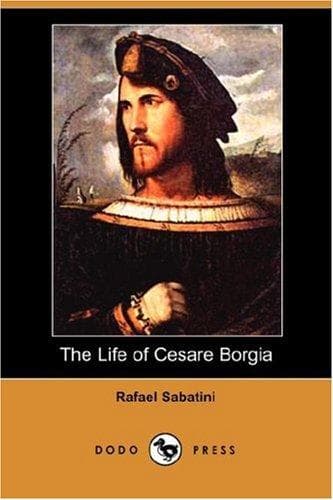
It all proved very reassuring to Guidobaldo who set his mind at ease
and never bethought him of looking to his defences, when, from Nocera,
Cesare made one of those sudden movements, terrible in their swiftness
as the spring of a tiger--enabling him to drive home his claws where
least expected. Leaving all baggage behind him, and with provisions
for only three days, he brought his troops by forced marches to Cagli,
within the Urbino State, and possessed himself of it almost before the
town had come to realize his presence.
Not until the citadel, taken entirely by surprise, was in Cesare’s hands
did a messenger speed to Guidobaldo with the unwelcome tidings that
the Duke of Valentinois was in arms, as an enemy, within the territory.
Together with that message came others into the garden of the Zoccolanti
monastery--that favourite resort of Guidobaldo’s--where he was indulging
his not unusual custom of supping in the cool of that summer evening.
They brought him word that, while Valentinois was advancing upon him
from the south, a force of 1,000 men were marching upon Urbino from
Isola di Fano in the east, and twice that number through the passes
of Sant’ Angelo and Verucchio in the north--all converging upon his
capital.
The attack had been shrewdly planned and timed, and if anything can
condone the treachery by which Guidobaldo was lulled into his false
security, it is the circumstance that this conduct of the matter avoided
bloodshed--a circumstance not wholly negligible, and one that was ever
a part of Cesare Borgia’s policy, save where punishment had to be
inflicted or reprisals taken.
Guidobaldo, seeing himself thus beset upon all sides at once, and
being all unprepared for resistance, perceived that nothing but flight
remained him; and that very night he left Urbino hurriedly, taking with
him the boy Francesco Maria, and intending at first to seek shelter in
his Castle of S. Leo--a fortress that was practically impregnable. But
already it was too late. The passes leading thither were by now in
the hands of the enemy, as Guidobaldo discovered at dawn. Thereupon,
changing his plans, he sent the boy and his few attendants to Bagno,
and, himself, disguised as a peasant, took to the hills, despite the
gout by which he was tormented. Thus he won to Ravenna, which was fast
becoming a home for dethroned princes.
Urbino, meanwhile, in no case to resist, sent its castellan to meet
Cesare and to make surrender to him--whereof Cesare, in the letter
already mentioned, gives news to the Pope, excusing himself for having
undertaken this thing without the Pope’s knowledge, but that “the
treachery employed against me by Guidobaldo was so enormous that I could
not suffer it.”
Public-domain text, read in full here on John Shaqi.
Reviews
Reviews
No reviews yet
Be the first to share your thoughts on this work.
Elsewhere in the archive
Join the Discussion
Join the discussion
Sign in to leave a comment or review.
Sign InorCreate an account