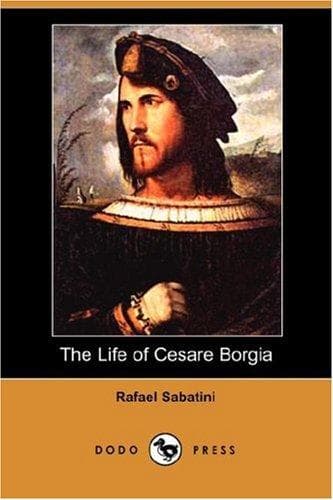
Within a few hours of poor Guidobaldo’s flight Cesare was housed in
Urbino’s splendid palace, whose stupendous library was the marvel of
all scholars of that day. Much of this, together with many of the
art-treasures collected by the Montefeltri, Cesare began shortly
afterwards to transfer to Cesena.
In addition to publishing an edict against pillage and violence in the
City of Urbino, Cesare made doubly sure that none should take place
by sending his soldiers to encamp at Fermignano, retaining near him in
Urbino no more than his gentlemen-at-arms. The capital being taken,
the remainder of the duchy made ready surrender, all the strongholds
announcing their submission to Cesare with the exception of that
almost inaccessible Castle of S. Leo, which capitulated only after a
considerable resistance.
From Urbino Cesare now entered into communication with the Florentines,
and asked that a representative should be sent to come to an agreement
with him. In response to this request, the Republic sent him Bishop
Soderini as her ambassador. The latter arrived in Urbino on June 25 and
was immediately and very cordially received by the duke. With him,
in the subordinate capacity of secretary, came a lean, small-headed,
tight-lipped man, with wide-set, intelligent eyes and prominent
cheek-bones--one Niccolò Macchiavelli, who, in needy circumstances at
present, and comparatively obscure, was destined to immortal fame. Thus
did Macchiavelli meet Cesare Borgia for the first time, and, for all
that we have no records of it, it is not to be doubted that his study of
that remarkable man began then in Urbino, to be continued presently,
as we shall see, when Macchiavelli returns to him in the quality of an
ambassador himself.
To Soderini the duke expounded his just grievance, founded upon the
Florentines’ unobservance of the treaty of Forno dei Campi; he demanded
that a fresh treaty should be drawn up to replace the broken one, and
that, for the purpose, Florence should change her government, as in
the ruling one, after what had passed, he could repose no faith. He
disclaimed all associations with the affair of Vitelli, but frankly
declared himself glad of it, as it had, no doubt, led Florence to
perceive what came of not keeping faith with him. He concluded by
assuring Soderini that, with himself for their friend, the Florentines
need fear no molestation from any one; but he begged that the Republic
should declare herself in the matter, since, if she did not care to have
him for her friend, she was, of course, at liberty to make of him her
enemy.
So impressed was Soderini by Cesare Borgia that on that same night he
wrote to the Signory:
Public-domain text, read in full here on John Shaqi.
Reviews
Reviews
No reviews yet
Be the first to share your thoughts on this work.
Elsewhere in the archive
Join the Discussion
Join the discussion
Sign in to leave a comment or review.
Sign InorCreate an account