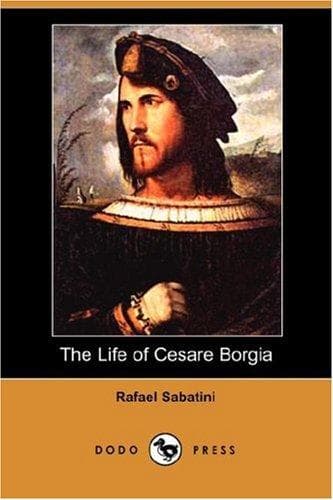
“This lord is very magnificent and splendid, and so spirited in feats of
arms that there is nothing so great but that it must seem small to him.
In the pursuit of glory and in the acquisition of dominions he never
rests, and he knows neither danger nor fatigue. He moves so swiftly that
he arrives at a place before it is known that he has set out for it.
He knows how to make himself beloved of his soldiers, and he has in his
service the best men of Italy. These things render him victorious and
formidable, and to these is yet to be added his perpetual good fortune.
He argues,” the Florentine envoy proceeds, “with such sound reason that
to dispute with him would be a long affair, for his wit and eloquence
never fail him” (“dello ingegno e della lingua si vale quanto vuole”).
You are to remember that this homage is one of the few surviving
impressions of one who came into personal contact with Cesare, and of
one, moreover, representing a Government more or less inimical to him,
who would therefore have no reason to draw a favourable portrait of
him for that Government’s benefit. One single page of such testimony is
worth a dozen volumes of speculation and inference drawn afterwards by
men who never knew him--in many cases by men who never began to know his
epoch.
The envoy concludes by informing the Signory that he has the duke’s
assurances that the latter has no thought of attempting to deprive
Florence of any of her possessions, as “the object of his campaign has
not been to tyrannize, but to extirpate tyrants.”
Whilst Cesare awaited the Florentines’ reply to their ambassador’s
communication, he withdrew to the camp at Fermignano, where he was
sought on July 6 by a herald from Louis XII. This messenger came to
exhort Cesare to embark upon no enterprise against the Florentine
Republic, because to offend Florence would be to offend the Majesty of
France. Simultaneously, however, Florence received messages from the
Cardinal d’Amboise, suggesting that they should come to terms with
Valentinois by conceding him at least a part of what had been agreed in
the Treaty of Forno dei Campi.
As a consequence, Soderini was able to inform Cesare that the Republic
was ready to treat with him, but that first he must withdraw Vitelli
from Arezzo, and compel him to yield up the captured fortresses. The
duke, not trusting--as he had frankly avowed--a Government which once
already had broken faith with him, and perceiving that, if he whistled
his war-dogs to heel as requested, he would have lost the advantages of
his position, refused to take any such steps until the treaty should be
concluded. He consented, however, to enforce meanwhile an armistice.
Public-domain text, read in full here on John Shaqi.
Reviews
Reviews
No reviews yet
Be the first to share your thoughts on this work.
Elsewhere in the archive
Join the Discussion
Join the discussion
Sign in to leave a comment or review.
Sign InorCreate an account