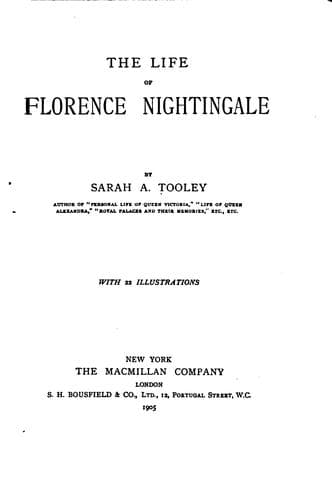
Nightingale, Florence, 1820-1910; Nurses -- England -- Biography
In a room to the left the date 1799 has been scratched upon one of the
window-panes, but the erection of the Hall must have been long before
that time. For the rest, it is a rambling old house with thick walls
and deep window embrasures. The ceilings are moderately high. There is
an old-fashioned garden at the back, with fruit and shady trees and a
particularly handsome copper beech.
The Hall has long been used as a farmhouse, and scarcely one out of
the hundreds of visitors to the Matlock district who go on pilgrimages
to Lea Hurst knows of its interesting association. The old lady who
occupied it at the time of my visit was not a little proud of the fact
that for forty-four years she had lived in the first English home of
Florence Nightingale.
The casual visitor might think the district amid which our heroine’s
early years were spent was a pleasant Derbyshire wild and nothing
more, but it has also much historic interest. Across the meadows from
Lea Hall are the remains of the stately mansion of Dethick, where
dwelt young Anthony Babington when he conspired to release Mary Queen
of Scots from her imprisonment at Wingfield Manor, a few miles away.
Over these same meadows and winding lanes Queen Elizabeth’s officers
searched for the conspirators and apprehended one at Dethick. The
mansion where the plot was hatched has been largely destroyed, and
what remains is used for farm purposes. Part of the old wall which
enclosed the original handsome building still stands, and beside it is
an underground cellar which according to tradition leads into a secret
passage to Wingfield Manor. The farm bailiff who stores his potatoes
in the cellar has not been able to find the entrance to the secret
passage, though at one side of the wall there is a suspicious hollow
sound when it is hammered.
The original kitchen of the mansion remains intact in the bailiff’s
farmhouse. There is the heavy oak-beamed ceiling, black with age, the
ponderous oak doors, the great open fireplace, desecrated by a modern
cooking range in the centre, but which still retains in the overhanging
beam the ancient roasting jack which possibly cooked venison for Master
Anthony and the other gallant young gentlemen who had sworn to liberate
the captive Queen. In the roof of the ceiling is an innocent-looking
little trap-door which, when opened, reveals a secret chamber of some
size. This delightful old kitchen, with its mysterious memories, was a
place of great fascination to Florence Nightingale and her sister in
their childhood, and many stories did they weave about the scenes which
transpired long ago in the old mansion, so near their own home. It was
a source of peculiar interest to have the scenes of a real Queen Mary
romance close at hand, and gave zest to the subject when the sisters
read about the Babington plot in their history books.
Public-domain text, read in full here on John Shaqi.
Reviews
Reviews
No reviews yet
Be the first to share your thoughts on this work.
Join the Discussion
Join the discussion
Sign in to leave a comment or review.
Sign InorCreate an account