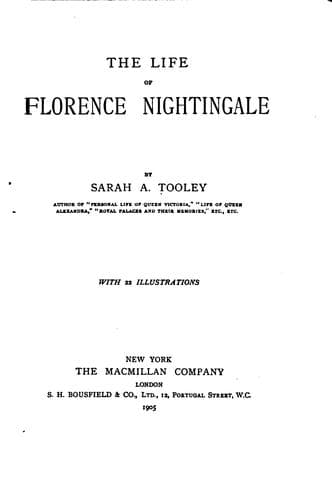
Nightingale, Florence, 1820-1910; Nurses -- England -- Biography
The Queen of Nurses combats the frequently accepted idea that cut
flowers and growing plants are unhealthy in a sick-room, even at night.
“The carbonic acid they give off at nights,” she writes, “would not
poison a fly. Nay, in overcrowded rooms they actually absorb carbonic
acid and give off oxygen. Cut flowers also decompose water and produce
oxygen gas.” The nurse should observe what colours are most pleasing to
her patient. “Some sick persons feel stimulus from looking at scarlet
flowers, others exhaustion from looking at deep blue.”
This reminds me of an incident which occurred while the present writer
was going over Netley Hospital when it was filled with wounded from
the battlefields of South Africa. The convalescent soldiers were doing
fancy woolwork, and a sister came into a ward bearing a parcel of wool
sent by a benevolent lady. When opened, the wool was found to be all
in khaki colour. The men turned their heads in disgust. “Didn’t we see
enough of khaki in South Africa, sister?” they exclaimed. “Why don’t
these kind ladies send us bright colours which will drive the thought
of khaki out of our minds.” A moment’s intelligent reflection on the
colours most likely to please the brave fellows at Netley would have
prevented such a foolish mistake. Miss Nightingale’s words of wisdom,
written forty years ago, are not obsolete yet.
The subject of “Taking Food” is next dealt with, and Miss Nightingale
vigorously attacks the accepted traditions. It is a common error “that
beef tea is the most nutritious of all articles. Now just try and boil
down a pound of beef into beef tea, evaporate your beef tea, and see
what is left of your beef--barely a tablespoonful of solid nourishment
to half a pint of water in beef tea.” Still, Miss Nightingale admits
that there is a certain reparative quality in beef tea, as in ordinary
tea. She denounces that favourite article with the friends of the sick,
jelly, which usually contains no nourishment at all.
Miss Nightingale is constantly called the “soldier’s friend” and one
may add that she is above all the patient’s friend. “Attend,” she
writes, “to the intelligent cravings of the sick. Patients crave
for things laid down in no sick dietary. It often happens that the
patient’s stomach is right and the book wrong. You can’t diet a patient
from a book.”
Public-domain text, read in full here on John Shaqi.
Reviews
Reviews
No reviews yet
Be the first to share your thoughts on this work.
Elsewhere in the archive
Join the Discussion
Join the discussion
Sign in to leave a comment or review.
Sign InorCreate an account