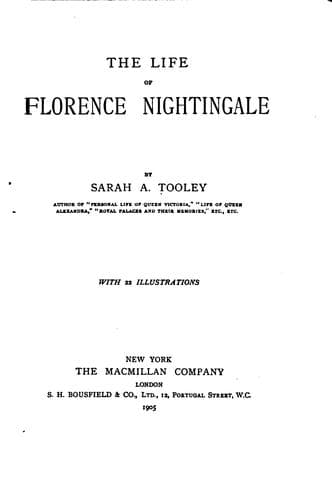
Nightingale, Florence, 1820-1910; Nurses -- England -- Biography
How many weary invalids will thank the Queen of Nurses for granting
them the too often condemned cup of tea. “A great deal too much against
tea is said by wise people,” she writes. “When you see the natural and
almost universal craving in English sick for their ‘tea,’ you cannot
but feel that Nature knows what she is about. I should be very glad if
any of the abusers of tea would point out what to give to an English
patient after a sleepless night, instead of tea. It is the almost
universal testimony of English men and women who have undergone great
fatigue, such as riding long journeys without stopping, or sitting up
for several nights in succession, that they could do it best upon an
occasional cup of tea--and nothing else. Let experience, not theory,
decide upon this as upon all other things.” Cocoa increases fat, but
has no restorative power, and it is “pure mockery to offer it as a
substitute for tea--you might,” adds Miss Nightingale, “as well offer
patients chestnuts instead of tea.” She gives the warning, however,
that too much tea is given to the sick by foolish people, and that as
a rule neither tea nor coffee should be given to invalids after five
o’clock.
The remarks on “Beds and Bedding” are not as relevant now as when
they were written in the days of the much be-curtained four-post
bedstead and luxurious feather beds. Most people now acknowledge
the superiority of the iron bedstead with spring mattress. The bed
coverings should be light as well as warm and “a true nurse,” says Miss
Nightingale, “always makes her patient’s bed and does not leave it to
the housemaid.” She recommends that the bed should always be in the
lightest place in the room, and the patient able to see out of window.
“A fashionable physician,” she writes, “has been saying that he turns
his patients’ faces from the light. Yes, but Nature is stronger than
fashionable physicians, and depend upon it, she turns the faces back
and _towards_ such light as she can get.” Observation of the sick shows
that patients do not turn their faces to the wall.
Miss Nightingale, in illustration of the craving of the sick to see out
of window, relates a beautiful story of a nurse’s self-sacrifice. A
poor man in one of the hospitals was suffering from spinal accident and
expressed an intense longing just to have one look out of the window.
The nurse, moved with compassion for the poor fellow’s craving, raised
him on her back so that he might take his coveted look at the outside
world once again. His joy was great, but the effort cost the nurse a
long and serious illness.
Public-domain text, read in full here on John Shaqi.
Reviews
Reviews
No reviews yet
Be the first to share your thoughts on this work.
Elsewhere in the archive
Join the Discussion
Join the discussion
Sign in to leave a comment or review.
Sign InorCreate an account