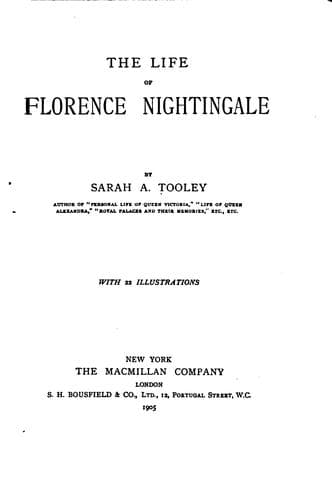
Nightingale, Florence, 1820-1910; Nurses -- England -- Biography
The system inaugurated by Miss Agnes Jones at Liverpool Infirmary
spread over the country, and Miss Nightingale had the satisfaction of
seeing in a comparatively short time a great improvement in the nursing
and treatment of the sick in workhouses. Gaols had long been visited
and reformed, lunatic asylums opened to inspection, and it seemed
unaccountable that the misery of sick workhouse paupers should have
been so long overlooked.[B]
[B] Miss Louisa Twining in 1854 began her pioneer efforts
in workhouse reform, which resulted in 1874 in the
establishment of the Workhouse Nursing Association.
The success of the introduction of trained nurses into workhouses
gave an impulse to sick poor nursing generally, and in 1868 the East
London Nursing Society was founded by the Hon. Mrs. Stuart Wortley and
Mr. Robert Wigram. In 1874 the movement received a further important
impulse from the formation of the National Nursing Association, to
provide skilled nurses for the sick poor in their own homes, to
establish district organisations in London and in the country, and to
establish a training school for district nurses in connection with one
of the London hospitals.
This work appealed most strongly to Miss Nightingale, and she expressed
her sympathy in the following letter to that devoted pioneer of
district nursing, Miss Florence Lees,[C] now Mrs. Dacre Craven, who
was the indefatigable honorary secretary of the newly founded National
Nursing Association.
[C] Miss Lees was described by Kinglake as “the gifted
and radiant pupil” of Florence Nightingale. She was a
probationer at the St. Thomas’s Training School when it was
temporarily located in the old Surrey Gardens.
“As to your success,” writes Miss Nightingale, “what is not your
success? To raise the homes of your patients so that they never fall
back again to dirt and disorder: such is your nurses’ influence. To
pull through life and death cases--cases which it would be an honour to
pull through with all the appurtenances of hospitals, or of the richest
in the land, and this without any sick-room appurtenances at all. To
keep whole families out of pauperism by preventing the home from being
broken up, and nursing the bread-winner back to health.”
Public-domain text, read in full here on John Shaqi.
Reviews
Reviews
No reviews yet
Be the first to share your thoughts on this work.
Elsewhere in the archive
Join the Discussion
Join the discussion
Sign in to leave a comment or review.
Sign InorCreate an account