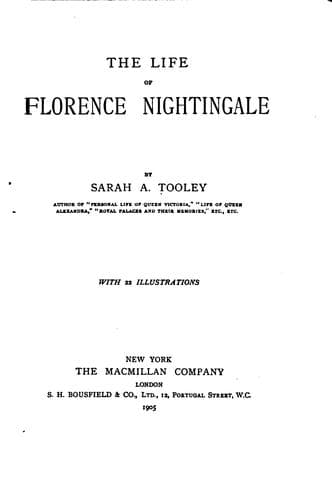
Nightingale, Florence, 1820-1910; Nurses -- England -- Biography
In her Derbyshire home she lived in touch with the life which at the
same period was weaving its spell about Marian Evans, when she visited
her kinspeople, and was destined to be immortalised in _Adam Bede_
and _The Mill on the Floss_. Amongst her father’s tenants Florence
Nightingale knew farmers’ wives who had a touch of Mrs. Poyser’s
caustic wit, and was familiar with the “Yea” and “Nay” and other quaint
forms of Derbyshire speech, such as Mr. Tulliver used when he talked
to “the little wench” in the house-place of the ill-fated Mill on the
Floss. She met, too, many of “the people called Methodists,” who in
her girlhood were establishing their preaching-places in the country
around Lea Hurst, and she heard of the fame of the woman preacher,
then exercising her marvellous gifts in the Derby district, who was
to become immortal as Dinah Morris. In Florence Nightingale’s early
womanhood, Adam Bede lived in his thatched cottage by Wirksworth Tape
Mills, a few miles from Lea Hurst, and the Poysers’ farm stood across
the meadows.
The childhood of our heroine was passed amid surroundings which
proved a singularly interesting environment. Steam power had not then
revolutionised rural England: the counties retained their distinctive
speech and customs, the young people remained on the soil where they
were born, and the rich and the poor were thrown more intimately
together. The effect of the greater personal intercourse then existing
between the squire’s family and his people had an important influence
on the character of Florence Nightingale in her Derbyshire and
Hampshire homes. She learned sympathy with the poor and afflicted,
and gained an understanding of the workings and prejudices of the
uneducated mind, which enabled her in after years to be a real friend
to those poor fellows fresh from the battlefields of the Crimea, many
of whom had enlisted from the class of rural homes which she knew so
well.
When quite a child, Florence Nightingale showed characteristics
which pointed to her vocation in life. Her dolls were always in a
delicate state of health and required the utmost care. Florence would
undress and put them to bed with many cautions to her sister not to
disturb them. She soothed their pillows, tempted them with imaginary
delicacies from toy cups and plates, and nursed them to convalescence,
only to consign them to a sick bed the next day. Happily, Parthe did
not exhibit the same tender consideration for her waxen favourites,
who frequently suffered the loss of a limb or got burnt at the nursery
fire. Then of course Florence’s superior skill was needed, and she
neatly bandaged poor dolly and “set” her arms and legs with a facility
which might be the envy of the modern miraculous bone-setter.
Public-domain text, read in full here on John Shaqi.
Reviews
Reviews
No reviews yet
Be the first to share your thoughts on this work.
Join the Discussion
Join the discussion
Sign in to leave a comment or review.
Sign InorCreate an account