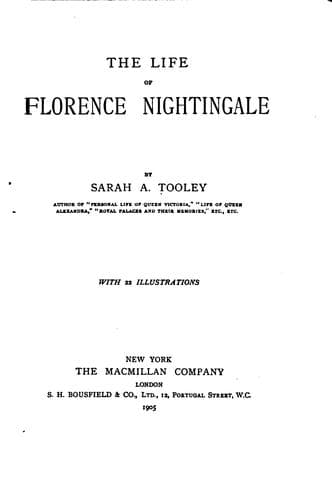
Nightingale, Florence, 1820-1910; Nurses -- England -- Biography
To-day it seems almost impossible to realise how novel was the idea of
a woman of birth and education becoming a nurse. Miss Nightingale was
a pioneer of the pioneers. She herself had not then any clear course
before her for the future, but she realised the important point that
she could not hope to accomplish anything without training. The faculty
was necessary and the desire to be helpful to the sick and suffering,
but a trained knowledge was the important thing. In a letter which
Miss Nightingale wrote in after years to young women on the subject of
“Work and Duty” she remarked: “I would say to all young ladies who are
called to any particular vocation, qualify yourselves for it as a man
does for his work. Don’t think you can undertake it otherwise. Submit
yourselves to the rules of business as men do, by which alone you
can make God’s business succeed; for He has never said that he will
give His success and his blessing to sketchy and unfinished work.” And
on another occasion she wrote: “Three-fourths of the whole mischief in
women’s lives arises from their excepting themselves from the rules of
training considered needful for men.”
This was the spirit in which Miss Nightingale entered upon her chosen
work, for she was the last person to “preach and not practise.” The
advice which she gave to other women, when she had herself risen to
the head of her profession, had been the guiding influence of her own
probation.
The beneficent work which distinguished her as the squire’s daughter
had given her useful experience, and had opened her eyes to the need
of trained nurses for the sick poor. What is now called “district
nursing” at this period exercised the mind of Florence Nightingale, and
her attention to military nursing was called forth later by a national
emergency.
It was at this critical period of her life, when her mind was shaping
itself to such high purpose, that Florence Nightingale met Elizabeth
Fry. The first grasping of hands of these two pioneer women would
serve as subject for a painter. We picture the stately and beautiful
old Quakeress in the characteristic garb of the Friends extending a
sisterly welcome to the young and earnest woman who came to learn
at her feet. The one was fast drawing to the close of her great work
for the women prisoners, and the other stood on the threshold of a
philanthropic career to be equally distinguished. We have no detailed
record of what words were spoken at this meeting, but we know that the
memory of the heavenly personality of Elizabeth Fry was an ever-present
inspiration with Florence Nightingale in the years which followed.
Public-domain text, read in full here on John Shaqi.
Reviews
Reviews
No reviews yet
Be the first to share your thoughts on this work.
Join the Discussion
Join the discussion
Sign in to leave a comment or review.
Sign InorCreate an account