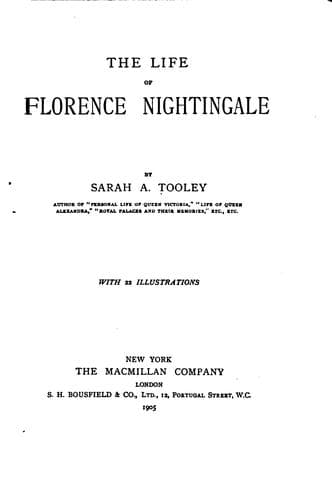
Nightingale, Florence, 1820-1910; Nurses -- England -- Biography
Miss Nightingale was at this period a pioneer of her sex and a
decidedly “advanced” woman, but the desire for freedom of action was
tempered by a naturally well-balanced nature. She put forward the plea
on women’s behalf that they should be encouraged to seek occupation
and properly trained for their work. In _Kaiserswerth_ she deals
more particularly with the vocation of a nurse or deaconess, but as
a prelude to the little work she refers to the position of women in
her own century. There is “an old legend,” she writes, “that the
nineteenth century is to be the century of women,” but she thinks that
up to the present (1851) it has not been theirs. She magnanimously
exempts man from blame. The fault, has not been his, for “in no
country has woman been given such freedom to cultivate her powers” as
in England. “She [woman] is no longer called pedantic if her powers
appear in conversation. The authoress is courted not shunned.” Women,
she thinks, have made extraordinary intellectual development, but
as human beings cannot move two feet at once, except they jump, so
while the intellectual foot of woman has made a step in advance, the
practical foot has remained behind. “Woman,” says Miss Nightingale,
“stands askew. Her education for action has not kept pace with her
education for acquirement. The woman of the eighteenth century was
perhaps happier, when practice and theory were on a par, than her more
cultivated sister of the nineteenth century. The latter wishes, but
does not know how to do many things! The former, what she wished at
least _that_ she could do.”
It appears that when Miss Nightingale was a young woman, the fashion
for extolling the single girl as against her sister who had entered
the bonds of matrimony was coming into vogue, but on this point our
heroine was racily sincere. “It has become of late the fashion,” she
says, “to cry up ‘old maids,’ to inveigh against regarding marriage as
the vocation of all women, to declare that a single life is as happy as
a married one, if people would but think so. So is the air as good an
element for fish as the water, if they did but know how to live in it.
Show us _how_ to be single and we will agree. But hitherto we have not
found that young Englishwomen have been convinced. And we must confess
that, _in the present state of things_, their horror of being ‘old
maids’ seems justified ... a life without love, and an activity without
an aim, is horrible in idea and wearisome in reality.”
Miss Nightingale does not touch on the point that the disparity between
the numbers of the sexes makes singleness not a choice but a necessity
to many women, and that in the interests of those who must remain
unwed, training for a definite calling in life should be given to girls
as well as to boys.
Public-domain text, read in full here on John Shaqi.
Reviews
Reviews
No reviews yet
Be the first to share your thoughts on this work.
Join the Discussion
Join the discussion
Sign in to leave a comment or review.
Sign InorCreate an account