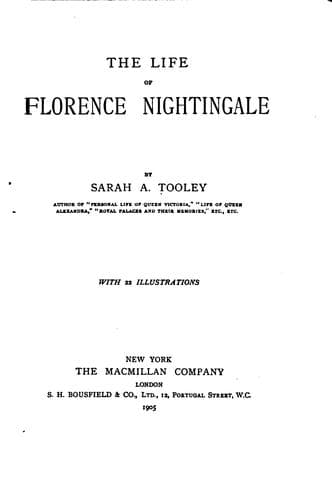
Nightingale, Florence, 1820-1910; Nurses -- England -- Biography
Acting on such distinguished advice I propose to attempt a slight
account of the career and personality of this singularly attractive
man, who was at the head of the War Office when Florence Nightingale
and her staff of nurses were sent to the aid of the soldiers wounded
in the Crimea. No _Life_ of Lord Herbert of Lea has at the time of
writing been published, although one is, I understand, in course of
preparation. The name of Sidney Herbert is distinguished as that of
the War Minister who, in defiance of official tradition, enlisted
the devotion and organising power of women on behalf of our soldiery
perishing in the pestilential hospitals of the East.
Sidney Herbert was born at Richmond in Surrey on September 16, 1810,
and was the second son of George Augustus, eleventh Earl of Pembroke,
by his second wife, Countess Catherine, only daughter of Count
Woronzoff, Russian Ambassador to the British Court. His maternal uncle,
Prince Michael Woronzoff, was a companion in arms of Wellington, and
the founder of the prosperous era in the Crimea. Sidney Herbert’s
mother, though of Russian birth, was chiefly brought up and educated
in this country, and owing to her father’s official position, moved as
a girl in the atmosphere of the Court. He owed much to her example and
training. She is described as having been a woman of quick intelligence
and sound judgment, of large generosity and noble bearing. Her husband,
Lord Pembroke, died when their son Sidney was about seventeen, and her
influence moulded his early manhood.
He was educated at Harrow under Dr. Butler, and matriculated at Oriel
College, Oxford, in 1828, where he was counted an elegant scholar and
noted as a speaker at the Union Debating Society, when he matched his
strength beside Gladstone, Roundell Palmer, and other distinguished
young orators. Upon his entrance into public life, as M.P. for South
Wiltshire in the first Reformed Parliament of 1832, Sidney Herbert was
considered a graceful and accomplished young Tory.
Sir Robert Peel on taking office in 1834 offered Sidney Herbert a post
in the Government, and it was characteristic of him that he refused the
Lordship of the Treasury because the duties were slight, and accepted
the laborious post of Secretary to the Board of Control, which he held
during Peel’s Administration. He returned to office with his old leader
in 1841 as Secretary to the Admiralty. While holding that position
Sidney Herbert set to work to reform the Naval School at Greenwich,
which then contained some eight hundred boys and was the nursing-ground
for the navy. While thus engaged he exhibited that administrative
faculty which was later so conspicuously shown in his efforts on behalf
of the sister service.
Public-domain text, read in full here on John Shaqi.
Reviews
Reviews
No reviews yet
Be the first to share your thoughts on this work.
Join the Discussion
Join the discussion
Sign in to leave a comment or review.
Sign InorCreate an account