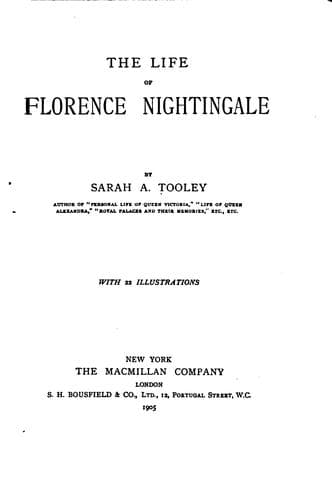
Nightingale, Florence, 1820-1910; Nurses -- England -- Biography
Her woman’s nature was roused to indignation at the sight of suffering
which she could only regard as the result of unbending and unthinking
routine, and she brought her quick intuitions and agile brain to
remedy the evil. When men were dying daily by the score for the want
of suitable nourishment, she declined to listen to under officials
who feared to disobey regulations by opening stores without the usual
order, and took the responsibility of having the packages undone. The
Lady-in-Chief was herself a strict disciplinarian, or she would never
have brought order out of chaos, but she had humanity enough to know
when the iron rule might be relaxed in the interests of those under
her care. Her common sense, her spirit of unselfish devotion, and her
strong, though gentle, persuasiveness gradually overcame the prejudice
of the constituted authorities against the new element introduced into
hospital work.
Mr. Sidney Herbert in his letter to the Principal Medical Officer at
Scutari (Dr. Menzies) announcing the coming of the nurses, had enjoined
him “to receive with attention and deference the counsels of the
Lady-in-Chief.” Great as was the power which the unflinching support
of this distinguished man gave her, it was secondary to the influence
which she attained by the force of her own character. The late Dean
Stanley, who was not a man to misuse the English language, described
Miss Nightingale’s faculty as “commanding genius.”
We read in the thrilling accounts of the period how the Lady-in-Chief
went her rounds at night, passing along the endless corridors and
through the hospital wards carrying a little lamp, the gleam of which
lighted her progress of mercy and love. Dying men turned on their
pillows to bless her shadow as it passed. In far-away New England the
idea of “The Lady with the Lamp” inspired the muse of Longfellow:--
A Lady with a Lamp shall stand
In the great history of the land,
A noble type of good
Heroic womanhood;
and it has remained the most beautiful and popular title bestowed upon
Florence Nightingale, but at the risk of appearing modern and prosaic
we venture to re-christen our heroine “The Lady with the Brain.”
Public-domain text, read in full here on John Shaqi.
Reviews
Reviews
No reviews yet
Be the first to share your thoughts on this work.
Elsewhere in the archive
Join the Discussion
Join the discussion
Sign in to leave a comment or review.
Sign InorCreate an account