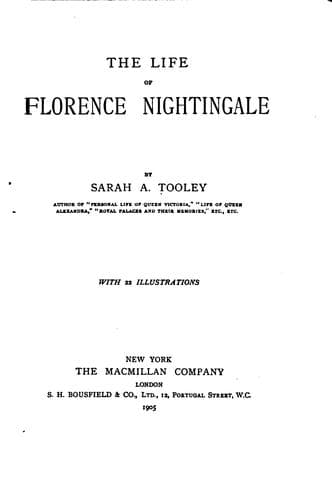
Nightingale, Florence, 1820-1910; Nurses -- England -- Biography
Not the least quality of the Lady-in-Chief was her influence over
men in authority. She was not dictatorial, she was not aggressive,
but she possessed the judgment which inspired confidence and the
knowledge which compelled respectful attention. Her letters to the War
Minister at home, and to Lord Raglan, the General in the field, were
models of clear and concise documents, devoid of grumbling, rancour,
or fidgety complaints, but they contained some appalling facts.
Unerringly she laid her finger on the loose joints of the commissariat
and hospital administration. By the enlightening aid of her letters
from Scutari the Home Government was enabled to pierce the haze which
surrounded the official accounts from the Bosphorus, and gradually the
hospital management was put on a footing which harmonised with the
Lady-in-Chief’s recommendations.
Lord William Paulet, who succeeded Major Sillery as Military Commandant
at Scutari shortly after Miss Nightingale’s arrival, soon learned
to place entire confidence in her judgment. “You will find her most
valuable, ... her counsels are admirable suggestions,” wrote the War
Minister to the new Commandant and Lord William proved the truth of
the statement. Lord Raglan in one of his dispatches to the Duke of
Newcastle said, “Lord William [Paulet] like Brown [Sir George Brown]
speaks loudly in praise of Miss Nightingale,” adding that he was
confident that she had “done great good.” As the weeks passed by, Lord
Raglan grew to consider the Lady-in-Chief a most efficient auxiliary
“general.”
CHAPTER XIII
_AT WORK IN THE BARRACK HOSPITAL_
An Appalling Task--Stories of Florence Nightingale’s interest in
the Soldiers--Lack of Necessaries for the Wounded--Establishes
an Invalids’ Kitchen and a Laundry--Cares for the Soldiers’
Wives--Religious Fanatics--Letter from Queen Victoria--Christmas
at Scutari.
Neglected, dying in despair,
They lay till woman came,
To soothe them with her gentle care,
And feed life’s flickering flame.
When wounded sore, on fever’s rack,
Or cast away as slain,
She called their fluttering spirits back,
And gave them strength again.
FRANCIS BENNOCH.
The events of the war in the autumn of 1854 will convey some idea of
the number of wounded men crowded into the hospitals on the Bosphorus
when Florence Nightingale entered upon her duties at Scutari. Balaclava
was fought on October 25th, four days after she left London; the battle
of Inkerman followed on November 5th, the day after she landed. Before
the average woman would have found time to unpack her boxes, Miss
Nightingale was face to face with a task unparalleled in its magnitude
and appalling in its nature.
Public-domain text, read in full here on John Shaqi.
Reviews
Reviews
No reviews yet
Be the first to share your thoughts on this work.
Elsewhere in the archive
Join the Discussion
Join the discussion
Sign in to leave a comment or review.
Sign InorCreate an account