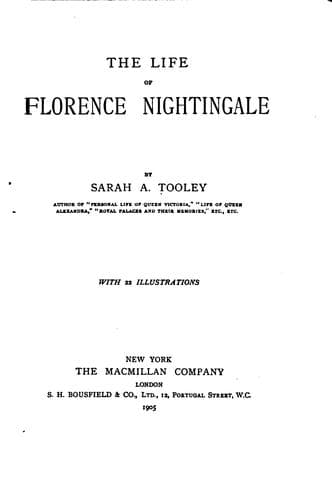
Nightingale, Florence, 1820-1910; Nurses -- England -- Biography
As a landlord he had a sincere desire to benefit the people on his
estates, although not perhaps in the way they most appreciated.
“Well, you see, I was not born generous,” is still remembered as Mr.
Nightingale’s answer when solicited for various local charities.
However, he never begrudged money for the support of rural education,
and, to quote the saying of one of his old tenants, “Many poor people
in Lea would not be able to read and write to-day, if it had not been
for ‘Miss Florence’s’ father.” He was the chief supporter of what was
then called the “cheap school,” where the boys and girls, if they did
not go through the higher standards of the present-day schools, at
least learned the three R’s for the sum of twopence a week. There was,
of course, no compulsory education then, but the displeasure of the
squire with people who neglected to send their children to school was a
useful incentive to parents. Mr. Nightingale was a zealous Churchman,
and did much to further Christian work in his district.
Florence Nightingale’s mother was Miss Frances Smith, daughter of
William Smith, Esq., of Parndon in Essex, who for fifty years was M.P.
for Norwich. He was a pronounced Abolitionist, took wide and liberal
views on the questions of the time, and was noted for his interest in
various branches of philanthropy. Mrs. Nightingale was imbued with
her father’s spirit, and is remembered for her great kindness and
benevolence to the poor. She was a stately and beautiful woman in her
prime and one of the fast-dying-out race of gentlewomen who were at
once notable house-keepers and charming and cultured ladies. Her name
is still mentioned with gratitude and affection by the old people of
her husband’s estates.
It was from her mother, whom she greatly resembles, that Florence
Nightingale inherited the spirit of wide philanthropy and the desire
to break away, in some measure, from the bonds of caste which warped
the county gentry in her early days and devote herself to humanitarian
work. She was also fortunate in having a father who believed that a
girl’s head could carry something more than elegant accomplishments and
a knowledge of cross-stitch. While our heroine’s mother trained her in
deeds of benevolence, her father inspired her with a love for knowledge
and guided her studies on lines much in advance of the usual education
given to young ladies at that period.
Mr. and Mrs. Nightingale had only two children--Frances Parthenope,
afterwards Lady Verney, and Florence, about a year younger. Both
sisters were named after the Italian towns where they were born, the
elder receiving the name of Parthenope, the classic form of Naples, and
was always known as “Parthe,” while our heroine was Florence.
CHAPTER II
_EARLIEST ASSOCIATIONS_
Lea Hall first English Home--Neighbourhood of Babington Plot--
Dethick Church.
Public-domain text, read in full here on John Shaqi.
Reviews
Reviews
No reviews yet
Be the first to share your thoughts on this work.
Join the Discussion
Join the discussion
Sign in to leave a comment or review.
Sign InorCreate an account