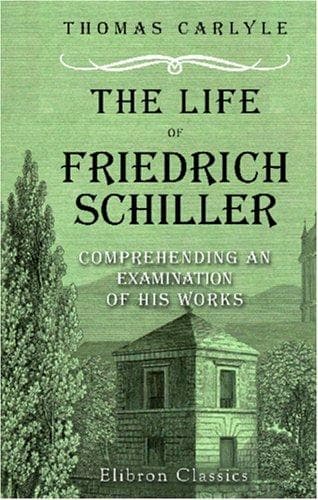
The Life of Friedrich Schiller: Comprehending an Examination of His WorksCarlyle, Thomas
General
The Life of Friedrich Schiller: Comprehending an Examination of His Works
Carlyle, Thomas
Authors, German -- 18th century -- Biography; Schiller, Friedrich, 1759-1805; Schubart, Christian Friedrich Daniel, 1739-1791
Under such corroding and continual vexations an ordinary spirit would
have sunk at length, would have gradually given up its loftier
aspirations, and sought refuge in vicious indulgence, or at best have
sullenly harnessed itself into the yoke, and plodded through
existence, weary, discontented, and broken, ever casting back a
hankering look upon the dreams of youth, and ever without power to
realise them. But Schiller was no ordinary character, and did not act
like one. Beneath a cold and simple exterior, dignified with no
artificial attractions, and marred in its native amiableness by the
incessant obstruction, the isolation and painful destitutions under
which he lived, there was concealed a burning energy of soul, which no
obstruction could extinguish. The hard circumstances of his fortune
had prevented the natural development of his mind; his faculties had
been cramped and misdirected; but they had gathered strength by
opposition and the habit of self-dependence which it encouraged. His
thoughts, unguided by a teacher, had sounded into the depths of his
own nature and the mysteries of his own fate; his feelings and
passions, unshared by any other heart, had been driven back upon his
own, where, like the volcanic fire that smoulders and fuses in secret,
they accumulated till their force grew irresistible.
Hitherto Schiller had passed for an unprofitable, a discontented and a
disobedient Boy: but the time was now come when the gyves of
school-discipline could no longer cripple and distort the giant might
of his nature: he stood forth as a Man, and wrenched asunder his
fetters with a force that was felt at the extremities of Europe. The
publication of the _Robbers_ forms an era not only in Schiller's
history, but in the Literature of the World; and there seems no doubt
that, but for so mean a cause as the perverted discipline of the
Stuttgard school, we had never seen this tragedy. Schiller commenced
it in his nineteenth year; and the circumstances under which it was
composed are to be traced in all its parts. It is the production of a
strong untutored spirit, consumed by an activity for which there is no
outlet, indignant at the barriers which restrain it, and grappling
darkly with the phantoms to which its own energy thus painfully
imprisoned gives being. A rude simplicity, combined with a gloomy and
overpowering force, are its chief characteristics; they remind us of
the defective cultivation, as well as of the fervid and harassed
feelings of its author. Above all, the latter quality is visible; the
tragic interest of the _Robbers_ is deep throughout, so deep that
frequently it borders upon horror. A grim inexpiable Fate is made the
ruling principle: it envelops and overshadows the whole; and under
its louring influence, the fiercest efforts of human will appear but
like flashes that illuminate the wild scene with a brief and terrible
splendour, and are lost forever in the darkness. The unsearchable
Public-domain text, read in full here on John Shaqi.
Reviews
Reviews
No reviews yet
Be the first to share your thoughts on this work.
Join the Discussion
Join the discussion
Sign in to leave a comment or review.
Sign InorCreate an account