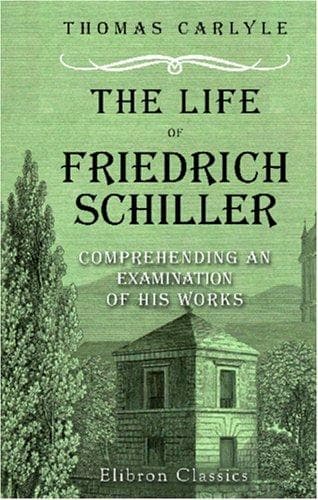
The Life of Friedrich Schiller: Comprehending an Examination of His WorksCarlyle, Thomas
General
The Life of Friedrich Schiller: Comprehending an Examination of His Works
Carlyle, Thomas
Authors, German -- 18th century -- Biography; Schiller, Friedrich, 1759-1805; Schubart, Christian Friedrich Daniel, 1739-1791
The introduction of supernatural agency in this play, and the final
aberration from the truth of history, have been considerably censured
by the German critics: Schlegel, we recollect, calls Joanna's end a
'rosy death.' In this dramaturgic discussion, the mere reader need
take no great interest. To require our belief in apparitions and
miracles, things which we cannot now believe, no doubt for a moment
disturbs our submission to the poet's illusions: but the miracles in
this story are rare and transient, and of small account in the general
result: they give our reason little trouble, and perhaps contribute to
exalt the heroine in our imaginations. It is still the mere human
grandeur of Joanna's spirit that we love and reverence; the lofty
devotedness with which she is transported, the generous benevolence,
the irresistible determination. The heavenly mandate is but the means
of unfolding these qualities, and furnishing them with a proper
passport to the minds of her age. To have produced, without the aid of
fictions like these, a Joanna so beautified and exalted, would
undoubtedly have yielded greater satisfaction: but it may be
questioned whether the difficulty would not have increased in a still
higher ratio. The sentiments, the characters, are not only accurate,
but exquisitely beautiful; the incidents, excepting the very last, are
possible, or even probable: what remains is but a very slender evil.
After all objections have been urged, and this among others has
certainly a little weight, the _Maid of Orleans_ will remain one of
the very finest of modern dramas. Perhaps, among all Schiller's plays,
it is the one which evinces most of that quality denominated _genius_
in the strictest meaning of the word. _Wallenstein_ embodies more
thought, more knowledge, more conception; but it is only in parts
illuminated by that ethereal brightness, which shines over every part
of this. The spirit of the romantic ages is here imaged forth; but the
whole is exalted, embellished, ennobled. It is what the critics call
idealised. The heart must be cold, the imagination dull, which the
_Jungfrau von Orleans_ will not move.
Public-domain text, read in full here on John Shaqi.
Reviews
Reviews
No reviews yet
Be the first to share your thoughts on this work.
Elsewhere in the archive
Join the Discussion
Join the discussion
Sign in to leave a comment or review.
Sign InorCreate an account