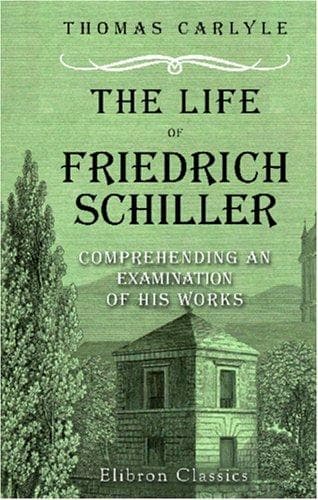
The Life of Friedrich Schiller: Comprehending an Examination of His WorksCarlyle, Thomas
General
The Life of Friedrich Schiller: Comprehending an Examination of His Works
Carlyle, Thomas
Authors, German -- 18th century -- Biography; Schiller, Friedrich, 1759-1805; Schubart, Christian Friedrich Daniel, 1739-1791
In Germany this case did not occur: the reception of the work was
beyond example flattering. The leading idea suited the German mind;
the execution of it inflamed the hearts and imaginations of the
people; they felt proud of their great poet, and delighted to
enthusiasm with his poetry. At the first exhibition of the play in
Leipzig, Schiller being in the theatre, though not among the
audience, this feeling was displayed in a rather singular manner. When
the curtain dropped at the end of the first act, there arose on all
sides a shout of "_Es lebe Friedrich Schiller!_" accompanied by the
sound of trumpets and other military music: at the conclusion of the
piece, the whole assembly left their places, went out, and crowded
round the door through which the poet was expected to come; and no
sooner did he show himself, than his admiring spectators, uncovering
their heads, made an avenue for him to pass; and as he waited along,
many, we are told, held up their children, and exclaimed, "_That is
he!_"[36]
[Footnote 36: Doering (p. 176);—who adds as follows:
'Another testimony of approval, very different in its nature,
he received at the first production of the play in Weimar.
Knowing and valuing, as he did, the public of that city, it
could not but surprise him greatly, when a certain young
Doctor S—-- called out to him, "_Bravo, Schiller!_" from the
gallery, in a very loud tone of voice. Offended at such
impertinence, the poet hissed strongly, in which the audience
joined him. He likewise expressed in words his displeasure at
this conduct; and the youthful sprig of medicine was, by
direction of the Court, farther punished for his indiscreet
applause, by some admonitions from the police.']
This must have been a proud moment for Schiller; but also an
agitating, painful one; and perhaps on the whole, the latter feeling,
for the time, prevailed. Such noisy, formal, and tumultuous plaudits
were little to his taste: the triumph they confer, though plentiful,
is coarse; and Schiller's modest nature made him shun the public gaze,
not seek it. He loved men, and did not affect to despise their
approbation; but neither did this form his leading motive. To him art,
like virtue, was its own reward; he delighted in his tasks for the
sake of the fascinating feelings which they yielded him in their
performance. Poetry was the chosen gift of his mind, which his
pleasure lay in cultivating: in other things he wished not that his
habits or enjoyments should be different from those of other men.
Public-domain text, read in full here on John Shaqi.
Reviews
Reviews
No reviews yet
Be the first to share your thoughts on this work.
Elsewhere in the archive
Join the Discussion
Join the discussion
Sign in to leave a comment or review.
Sign InorCreate an account