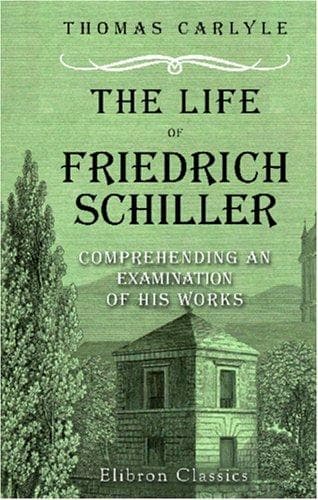
The Life of Friedrich Schiller: Comprehending an Examination of His WorksCarlyle, Thomas
General
The Life of Friedrich Schiller: Comprehending an Examination of His Works
Carlyle, Thomas
Authors, German -- 18th century -- Biography; Schiller, Friedrich, 1759-1805; Schubart, Christian Friedrich Daniel, 1739-1791
At Weimar his present way of life was like his former one at Jena: his
business was to study and compose; his recreations were in the circle
of his family, where he could abandon himself to affections, grave or
trifling, and in frank and cheerful intercourse with a few friends. Of
the latter he had lately formed a social club, the meetings of which
afforded him a regular and innocent amusement. He still loved solitary
walks: in the Park at Weimar he might frequently be seen wandering
among the groves and remote avenues, with a note-book in his hand; now
loitering slowly along, now standing still, now moving rapidly on; if
any one appeared in sight, he would dart into another alley, that his
dream might not be broken.[37] 'One of his favourite resorts,' we are
told, 'was the thickly-overshadowed rocky path which leads to the
_Römische Haus_, a pleasure-house of the Duke's, built under the
direction of Goethe. There he would often sit in the gloom of the
crags, overgrown with cypresses and boxwood; shady hedges before him;
not far from the murmur of a little brook, which there gushes in a
smooth slaty channel, and where some verses of Goethe are cut upon a
brown plate of stone, and fixed in the rock.' He still continued to
study in the night: the morning was spent with his children and his
wife, or in pastimes such as we have noticed; in the afternoon he
revised what had been last composed, wrote letters, or visited his
friends. His evenings were often passed in the theatre; it was the
only public place of amusement which he ever visited; nor was it for
the purpose of amusement that he visited this: it was his observatory,
where he watched the effect of scenes and situations; devised new
schemes of art, or corrected old ones. To the players he was kind,
friendly: on nights when any of his pieces had been acted successfully
or for the first time, he used to invite the leaders of the company to
a supper in the Stadthaus, where the time was spent in mirthful
diversions, one of which was frequently a recitation, by Genast, of
the Capuchin's sermon in _Wallenstein's Camp_. Except on such rare
occasions, he returned home directly from the theatre, to light his
midnight lamp, and commence the most earnest of his labours.
[Footnote 37: 'Whatever he intended to write, he first
composed in his head, before putting down a line of it on
paper. He used to call a work _ready_ so soon as its
existence in his spirit was complete: hence in the public
there often were reports that such and such a piece of his
was finished, when, in the common sense, it was not even
begun.'—_Jördens Lexicon_, § SCHILLER.]
Public-domain text, read in full here on John Shaqi.
Reviews
Reviews
No reviews yet
Be the first to share your thoughts on this work.
Elsewhere in the archive
Join the Discussion
Join the discussion
Sign in to leave a comment or review.
Sign InorCreate an account