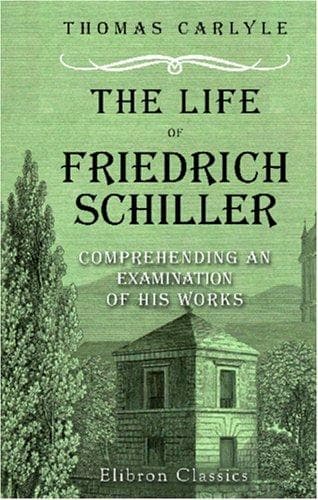
The Life of Friedrich Schiller: Comprehending an Examination of His WorksCarlyle, Thomas
General
The Life of Friedrich Schiller: Comprehending an Examination of His Works
Carlyle, Thomas
Authors, German -- 18th century -- Biography; Schiller, Friedrich, 1759-1805; Schubart, Christian Friedrich Daniel, 1739-1791
The slight degree of failure or miscalculation which occurred in the
present instance, was next year abundantly redeemed. _Wilhelm Tell_,
sent out in 1804, is one of Schiller's very finest dramas; it exhibits
some of the highest triumphs which his genius, combined with his art,
ever realised. The first descent of Freedom to our modern world, the
first unfurling of her standard on the rocky pinnacle of Europe, is
here celebrated in the style which it deserved. There is no false
timsel-decoration about _Tell_, no sickly refinement, no declamatory
sentimentality. All is downright, simple, and agreeable to Nature;
yet all is adorned and purified and rendered beautiful, without losing
its resemblance. An air of freshness and wholesomeness breathes over
it; we are among honest, inoffensive, yet fearless peasants, untainted
by the vices, undazzled by the theories, of more complex and perverted
conditions of society. The opening of the first scene sets us down
among the Alps. It is 'a high rocky shore of the Luzern Lake, opposite
to Schwytz. The lake makes a little bight in the land, a hut stands at
a short distance from the bank, the fisher-boy is rowing himself about
in his boat. Beyond the lake, on the other side, we see the green
meadows, the hamlets and farms of Schwytz, lying in the clear
sunshine. On our left are observed the peaks of the Hacken surrounded
with clouds: to the right, and far in the distance, appear the
glaciers. We hear the _rance des vaches_ and the tinkling of
cattle-bells.' This first impression never leaves us; we are in a
scene where all is grand and lovely; but it is the loveliness and
grandeur of unpretending, unadulterated Nature. These Switzers are not
Arcadian shepherds or speculative patriots; there is not one crook or
beechen bowl among them, and they never mention the Social Contract,
or the Rights of Man. They are honest people, driven by oppression to
assert their privileges; and they go to work like men in earnest, bent
on the despatch of business, not on the display of sentiment. They are
not philosophers or tribunes; but frank, stalwart landmen: even in the
field of Rütli, they do not forget their common feelings; the party
that arrive first indulge in a harmless little ebullition of parish
vanity: "_We_ are first here!" they say, "we Unterwaldeners!" They
have not charters or written laws to which they can appeal; but they
have the traditionary rights of their fathers, and bold hearts and
strong arms to make them good. The rules by which they steer are not
deduced from remote premises, by a fine process of thought; they are
the accumulated result of experience, transmitted from peasant sire to
peasant son. There is something singularly pleasing in this exhibition
of genuine humanity; of wisdom, embodied in old adages and practical
maxims of prudence; of magnanimity, displayed in the quiet
unpretending discharge of the humblest every-day duties. Truth is
Public-domain text, read in full here on John Shaqi.
Reviews
Reviews
No reviews yet
Be the first to share your thoughts on this work.
Elsewhere in the archive
Join the Discussion
Join the discussion
Sign in to leave a comment or review.
Sign InorCreate an account