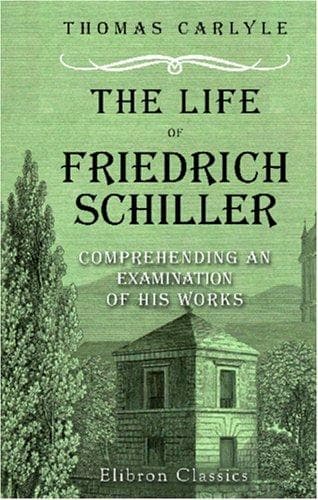
The Life of Friedrich Schiller: Comprehending an Examination of His WorksCarlyle, Thomas
General
The Life of Friedrich Schiller: Comprehending an Examination of His Works
Carlyle, Thomas
Authors, German -- 18th century -- Biography; Schiller, Friedrich, 1759-1805; Schubart, Christian Friedrich Daniel, 1739-1791
superior to Fiction: we feel at home among these brave good people;
their fortune interests us more than that of all the brawling, vapid,
sentimental heroes in creation. Yet to make them interest us was the
very highest problem of art; it was to copy lowly Nature, to give us a
copy of it embellished and refined by the agency of genius, yet
preserving the likeness in every lineament. The highest quality of art
is to conceal itself: these peasants of Schiller's are what every one
imagines he could imitate successfully; yet in the hands of any but a
true and strong-minded poet they dwindle into repulsive coarseness or
mawkish insipidity. Among our own writers, who have tried such
subjects, we remember none that has succeeded equally with Schiller.
One potent but ill-fated genius has, in far different circumstances
and with far other means, shown that he could have equalled him: the
_Cotter's Saturday Night_ of Burns is, in its own humble way, as
quietly beautiful, as _simplex munditiis_, as the scenes of _Tell_. No
other has even approached them; though some gifted persons have
attempted it. Mr. Wordsworth is no ordinary man; nor are his pedlars,
and leech-gatherers, and dalesmen, without their attractions and their
moral; but they sink into whining drivellers beside _Rösselmann the
Priest_, _Ulric the Smith_, _Hans of the Wall_, and the other sturdy
confederates of Rütli.
The skill with which the events are concatenated in this play
corresponds to the truth of its delineation of character. The
incidents of the Swiss Revolution, as detailed in Tschudi or Müller,
are here faithfully preserved, even to their minutest branches. The
beauty of Schiller's descriptions all can relish; their fidelity is
what surprises every reader who has been in Switzerland. Schiller
never saw the scene of his play; but his diligence, his quickness and
intensity of conception, supplied this defect. Mountain and
mountaineer, conspiracy and action, are all brought before us in their
true forms, all glowing in the mild sunshine of the poet's fancy. The
tyranny of Gessler, and the misery to which it has reduced the land;
the exasperation, yet patient courage of the people; their characters,
and those of their leaders, Fürst, Stauffacher, and Melchthal; their
exertions and ultimate success, described as they are here, keep up a
constant interest in the piece. It abounds in action, as much as the
_Bride of Messina_ is defective in that point.
Public-domain text, read in full here on John Shaqi.
Reviews
Reviews
No reviews yet
Be the first to share your thoughts on this work.
Elsewhere in the archive
Join the Discussion
Join the discussion
Sign in to leave a comment or review.
Sign InorCreate an account