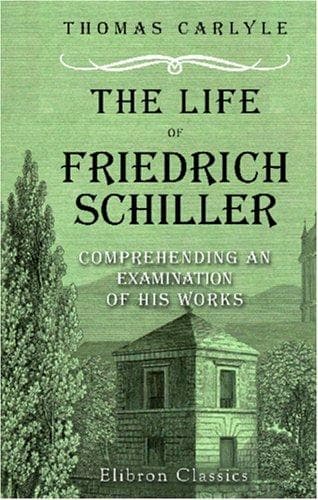
The Life of Friedrich Schiller: Comprehending an Examination of His WorksCarlyle, Thomas
General
The Life of Friedrich Schiller: Comprehending an Examination of His Works
Carlyle, Thomas
Authors, German -- 18th century -- Biography; Schiller, Friedrich, 1759-1805; Schubart, Christian Friedrich Daniel, 1739-1791
Combined and partly of kindred with these intellectual faculties was
that vehemence of temperament which is necessary for their full
development. Schiller's heart was at once fiery and tender; impetuous,
soft, affectionate, his enthusiasm clothed the universe with grandeur,
and sent his spirit forth to explore its secrets and mingle warmly in
its interests. Thus poetry in Schiller was not one but many gifts. It
was not the 'lean and flashy song' of an ear apt for harmony, combined
with a maudlin sensibility, or a mere animal ferocity of passion, and
an imagination creative chiefly because unbridled: it was, what true
poetry is always, the quintessence of general mental riches, the
purified result of strong thought and conception, and of refined as
well as powerful emotion. In his writings, we behold him a moralist, a
philosopher, a man of universal knowledge: in each of these capacities
he is great, but also in more; for all that he achieves in these is
brightened and gilded with the touch of another quality; his maxims,
his feelings, his opinions are transformed from the lifeless shape of
didactic truths, into living shapes that address faculties far finer
than the understanding.
The gifts by which such transformation is effected, the gift of pure,
ardent, tender sensibility, joined to those of fancy and imagination,
are perhaps not wholly denied to any man endowed with the power of
reason; possessed in various degrees of strength, they add to the
products of mere intellect corresponding tints of new attractiveness;
in a degree great enough to be remarkable they constitute a poet. Of
this peculiar faculty how much had fallen to Schiller's lot, we need
not attempt too minutely to explain. Without injuring his reputation,
it may be admitted that, in general, his works exhibit rather
extraordinary strength than extraordinary fineness or versatility. His
power of dramatic imitation is perhaps never of the very highest, the
Shakspearean kind; and in its best state, it is farther limited to a
certain range of characters. It is with the grave, the earnest, the
exalted, the affectionate, the mournful, that he succeeds: he is not
destitute of humour, as his _Wallenstein's Camp_ will show, but
neither is he rich in it; and for sprightly ridicule in any of its
forms he has seldom shown either taste or talent. Chance principally
made the drama his department; he might have shone equally in many
others. The vigorous and copious invention, the knowledge of life, of
men and things, displayed in his theatrical pieces, might have been
available in very different pursuits; frequently the charm of his
works has little to distinguish it from the charm of intellectual and
moral force in general; it is often the capacious thought, the vivid
imagery, the impetuous feeling of the orator, rather than the wild
pathos and capricious enchantment of the poet. Yet that he was capable
of rising to the loftiest regions of poetry, no reader of his _Maid of
Public-domain text, read in full here on John Shaqi.
Reviews
Reviews
No reviews yet
Be the first to share your thoughts on this work.
Elsewhere in the archive
Join the Discussion
Join the discussion
Sign in to leave a comment or review.
Sign InorCreate an account