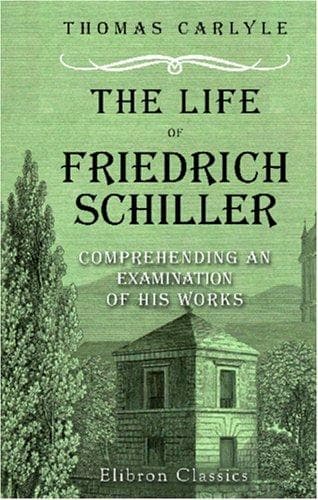
The Life of Friedrich Schiller: Comprehending an Examination of His WorksCarlyle, Thomas
General
The Life of Friedrich Schiller: Comprehending an Examination of His Works
Carlyle, Thomas
Authors, German -- 18th century -- Biography; Schiller, Friedrich, 1759-1805; Schubart, Christian Friedrich Daniel, 1739-1791
Orleans_, his character of Thekla, or many other of his pieces, will
hesitate to grant. Sometimes we suspect that it is the very grandeur
of his general powers which prevents us from exclusively admiring his
poetic genius. We are not lulled by the syren song of poetry, because
her melodies are blended with the clearer, manlier tones of serious
reason, and of honest though exalted feeling.
Much laborious discussion has been wasted in defining genius,
particularly by the countrymen of Schiller, some of whom have narrowed
the conditions of the term so far, as to find but three _men of
genius_ since the world was created: Homer, Shakspeare, and Goethe!
From such rigid precision, applied to a matter in itself indefinite,
there may be an apparent, but there is no real, increase of accuracy.
The creative power, the faculty not only of imitating given forms of
being, but of imagining and representing new ones, which is here
attributed with such distinctness and so sparingly, has been given by
nature in complete perfection to no man, nor entirely denied to any.
The shades of it cannot be distinguished by so loose a scale as
language. A definition of genius which excludes such a mind as
Schiller's will scarcely be agreeable to philosophical correctness,
and it will tend rather to lower than to exalt the dignity of the
word. Possessing all the general mental faculties in their highest
degree of strength, an intellect ever active, vast, powerful,
far-sighted; an imagination never weary of producing grand or
beautiful forms; a heart of the noblest temper, sympathies
comprehensive yet ardent, feelings vehement, impetuous, yet full of
love and kindliness and tender pity; conscious of the rapid and fervid
exercise of all these powers within him, and able farther to present
their products refined and harmonised, and 'married to immortal
verse,' Schiller may or may not be called a man of genius by his
critics; but his mind in either case will remain one of the most
enviable which can fall to the share of a mortal.
Public-domain text, read in full here on John Shaqi.
Reviews
Reviews
No reviews yet
Be the first to share your thoughts on this work.
Elsewhere in the archive
Join the Discussion
Join the discussion
Sign in to leave a comment or review.
Sign InorCreate an account