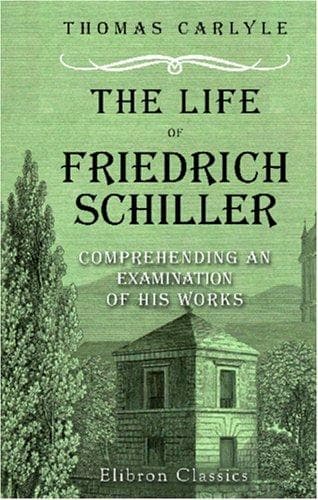
The Life of Friedrich Schiller: Comprehending an Examination of His WorksCarlyle, Thomas
General
The Life of Friedrich Schiller: Comprehending an Examination of His Works
Carlyle, Thomas
Authors, German -- 18th century -- Biography; Schiller, Friedrich, 1759-1805; Schubart, Christian Friedrich Daniel, 1739-1791
Such, so far as we can represent it, is the form in which Schiller's
life and works have gradually painted their character in the mind of a
secluded individual, whose solitude he has often charmed, whom he has
instructed, and cheered, and moved. The original impression, we know,
was faint and inadequate, the present copy of it is still more so; yet
we have sketched it as we could: the figure of Schiller, and of the
figures he conceived and drew are there; himself, 'and in his hand a
glass which shows us many more.' To those who look on him as we have
wished to make them, Schiller will not need a farther panegyric. For
the sake of Literature, it may still be remarked, that his merit was
peculiarly due to her. Literature was his creed, the dictate of his
conscience; he was an Apostle of the Sublime and Beautiful, and this
his calling made a hero of him. For it was in the spirit of a true man
that he viewed it, and undertook to cultivate it; and its inspirations
constantly maintained the noblest temper in his soul. The end of
Literature was not, in Schiller's judgment, to amuse the idle, or to
recreate the busy, by showy spectacles for the imagination, or quaint
paradoxes and epigrammatic disquisitions for the understanding: least
of all was it to gratify in any shape the selfishness of its
professors, to minister to their malignity, their love of money, or
even of fame. For persons who degrade it to such purposes, the deepest
contempt of which his kindly nature could admit was at all times in
store. 'Unhappy mortal!' says he to the literary tradesman, the man
who writes for gain, 'Unhappy mortal, who with science and art, the
noblest of all instruments, effectest and attemptest nothing more than
the day-drudge with the meanest; who, in the domain of perfect
Freedom, bearest about in thee the spirit of Slave!' As Schiller
viewed it, genuine Literature includes the essence of philosophy,
religion, art; whatever speaks to the immortal part of man. The
daughter, she is likewise the nurse of all that is spiritual and
exalted in our character. The boon she bestows is truth; truth not
merely physical, political, economical, such as the sensual man in us
is perpetually demanding, ever ready to reward, and likely in general
to find; but truth of moral feeling, truth of taste, that inward truth
in its thousand modifications, which only the most ethereal portion of
our nature can discern, but without which that portion of it
languishes and dies, and we are left divested of our birthright,
thenceforward 'of the earth earthy,' machines for earning and
enjoying, no longer worthy to be called the Sons of Heaven. The
treasures of Literature are thus celestial, imperishable, beyond all
price: with her is the shrine of our best hopes, the palladium of pure
manhood; to be among the guardians and servants of this is the noblest
function that can be intrusted to a mortal. Genius, even in its
faintest scintillations, is 'the inspired gift of God;' a solemn
Public-domain text, read in full here on John Shaqi.
Reviews
Reviews
No reviews yet
Be the first to share your thoughts on this work.
Elsewhere in the archive
Join the Discussion
Join the discussion
Sign in to leave a comment or review.
Sign InorCreate an account