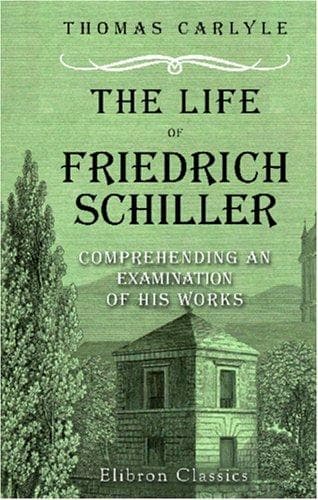
The Life of Friedrich Schiller: Comprehending an Examination of His WorksCarlyle, Thomas
General
The Life of Friedrich Schiller: Comprehending an Examination of His Works
Carlyle, Thomas
Authors, German -- 18th century -- Biography; Schiller, Friedrich, 1759-1805; Schubart, Christian Friedrich Daniel, 1739-1791
mandate to its owner to go forth and labour in his sphere, to keep
alive 'the sacred fire' among his brethren, which the heavy and
polluted atmosphere of this world is forever threatening to
extinguish. Woe to him if he neglect this mandate, if he hear not its
small still voice! Woe to him if he turn this inspired gift into the
servant of his evil or ignoble passions; if he offer it on the altar
of vanity, if he sell it for a piece of money!
'The Artist, it is true,' says Schiller, 'is the son of his age; but
pity for him if he is its pupil, or even its favourite! Let some
beneficent Divinity snatch him when a suckling from the breast of his
mother, and nurse him with the milk of a better time; that he may
ripen to his full stature beneath a distant Grecian sky. And having
grown to manhood, let him return, a foreign shape, into his century;
not, however, to delight it by his presence; but terrible, like the
Son of Agamemnon, to purify it. The Matter of his works he will take
from the present; but their Form he will derive from a nobler time,
nay from beyond all time, from the absolute unchanging unity of his
nature. Here from the pure æther of his spiritual essence, flows down
the Fountain of Beauty, uncontaminated by the pollutions of ages and
generations, which roll to and fro in their turbid vortex far beneath
it. His Matter caprice can dishonour as she has ennobled it; but the
chaste Form is withdrawn from her mutations. The Roman of the first
century had long bent the knee before his Cæsars, when the statues of
Rome were still standing erect; the temples continued holy to the eye,
when their gods had long been a laughing-stock; and the abominations
of a Nero and a Commodus were silently rebuked by the style of the
edifice which lent them its concealment. Man has lost his dignity, but
Art has saved it, and preserved it for him in expressive marbles.
Truth still lives in fiction, and from the copy the original will be
restored.
'But how is the Artist to guard himself from the corruptions of his
time, which on every side assail him? By despising its decisions. Let
him look upwards to his dignity and his mission, not downwards to his
happiness and his wants. Free alike from the vain activity, that longs
to impress its traces on the fleeting instant; and from the
discontented spirit of enthusiasm, that measures by the scale of
perfection the meagre product of reality, let him leave to _common
sense_, which is here at home, the province of the actual; while _he_
strives from the union of the possible with the necessary to bring out
the ideal. This let him imprint and express in fiction and truth,
imprint it in the sport of his imagination and the earnest of his
actions, imprint it in all sensible and spiritual forms, and cast it
silently into everlasting Time.'[40]
[Footnote 40: _Über die æsthetische Erziehung des Menschen._]
Public-domain text, read in full here on John Shaqi.
Reviews
Reviews
No reviews yet
Be the first to share your thoughts on this work.
Elsewhere in the archive
Join the Discussion
Join the discussion
Sign in to leave a comment or review.
Sign InorCreate an account