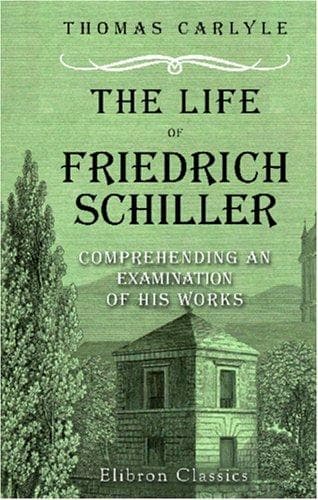
The Life of Friedrich Schiller: Comprehending an Examination of His WorksCarlyle, Thomas
General
The Life of Friedrich Schiller: Comprehending an Examination of His Works
Carlyle, Thomas
Authors, German -- 18th century -- Biography; Schiller, Friedrich, 1759-1805; Schubart, Christian Friedrich Daniel, 1739-1791
Nor were these sentiments, be it remembered, the mere boasting
manifesto of a hot-brained inexperienced youth, entering on literature
with feelings of heroic ardour, which its difficulties and temptations
would soon deaden or pervert: they are the calm principles of a man,
expressed with honest manfulness, at a period when the world could
compare them with a long course of conduct. In this just and lofty
spirit, Schiller undertook the business of literature; in the same
spirit he pursued it with unflinching energy all the days of his life.
The common, and some uncommon, difficulties of a fluctuating and
dependent existence could not quench or abate his zeal: sickness
itself seemed hardly to affect him. During his last fifteen years, he
wrote his noblest works; yet, as it has been proved too well, no day
of that period could have passed without its load of pain.[41] Pain
could not turn him from his purpose, or shake his equanimity: in death
itself he was _calmer and calmer_. Nor has he gone without his
recompense. To the credit of the world it can be recorded, that their
suffrages, which he never courted, were liberally bestowed on him:
happier than the mighty Milton, he found 'fit hearers,' even in his
lifetime, and they were not 'few.' His effect on the mind of his own
country has been deep and universal, and bids fair to be abiding: his
effect on other countries must in time be equally decided; for such
nobleness of heart and soul shadowed forth in beautiful imperishable
emblems, is a treasure which belongs not to one nation, but to all. In
another age, this Schiller will stand forth in the foremost rank among
the master-spirits of his century; and be admitted to a place among
the chosen of all centuries. His works, the memory of what he did and
was, will rise afar off like a towering landmark in the solitude of
the Past, when distance shall have dwarfed into invisibility the
lesser people that encompassed him, and hid him from the near
beholder.
[Footnote 41: On a surgical inspection of his body after
death, the most vital organs were found totally deranged.
'The structure of the lungs was in great part destroyed, the
cavities of the heart were nearly grown up, the liver had
become hard, and the gall-bladder was extended to an
extraordinary size.' _Doering._]
Public-domain text, read in full here on John Shaqi.
Reviews
Reviews
No reviews yet
Be the first to share your thoughts on this work.
Elsewhere in the archive
Join the Discussion
Join the discussion
Sign in to leave a comment or review.
Sign InorCreate an account