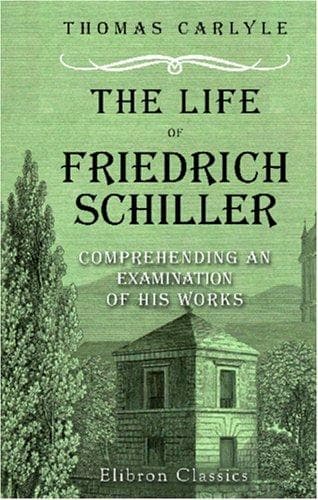
The Life of Friedrich Schiller: Comprehending an Examination of His WorksCarlyle, Thomas
General
The Life of Friedrich Schiller: Comprehending an Examination of His Works
Carlyle, Thomas
Authors, German -- 18th century -- Biography; Schiller, Friedrich, 1759-1805; Schubart, Christian Friedrich Daniel, 1739-1791
'In the original, the Robbers are exhibited in strong
contrast with each other; and I dare maintain that it is
difficult to draw half a dozen robbers in strong contrast,
without in some of them offending the delicacy of the stage.
In my first conception of the piece, I excluded the idea of
its ever being represented in a theatre; hence came it that
Franz was planned as a _reasoning_ villain; a plan which,
though it may content the thinking Reader, cannot fail to vex
and weary the Spectator, who does not come to think, and who
wants not philosophy, but action.
'In the new edition, I could not overturn this arrangement
without breaking-down the whole economy of the piece.
Accordingly I can predict, with tolerable certainty, that
Franz when he appears on the stage, will not play the part
which he has played with the reader. And, at all events, the
rushing stream of the action will hurry the spectator over
all the finer shadings, and rob him of a third part of the
whole character.
'Karl von Moor might chance to form an era on the stage;
except a few speculations, which, however, work as
indispensable colours in the general picture, he is all
action, all visible life. Spiegelberg, Schweitzer, Hermann,
are, in the strictest sense, personages for the stage; in a
less degree, Amelia and the Father.
'Written and oral criticisms I have endeavoured to turn to
advantage. The alterations are important; certain scenes are
altogether new. Of this number, are Hermann's counter-plots
to undermine the schemes of Franz; his interview with that
personage, which, in the first composition of the work, was
entirely and very unhappily forgotten. His interview with
Amelia in the garden has been postponed to the succeeding
act; and my friends tell me that I could have fixed upon no
better act than this, no better time than a few moments prior
to the meeting of Amelia with Moor. Franz is brought a little
nearer human nature; but the mode of it is rather strange. A
scene like his condemnation in the fifth act has never, to my
knowledge, been exhibited on any stage; and the same may be
said of the scene where Amelia is sacrificed by her lover.
'If the piece should be too long, it stands at the discretion
of the manager to abbreviate the speculative parts of it, or
here and there, without prejudice to the general impression,
to omit them altogether. But in the _printing_, I use the
freedom humbly to protest against the leaving out of
anything. I had satisfactory reasons of my own for all that I
allowed to pass; and my submission to the stage does not
extend so far, that I can leave _holes_ in my work, and
mutilate the characters of men for the convenience of actors.
Public-domain text, read in full here on John Shaqi.
Reviews
Reviews
No reviews yet
Be the first to share your thoughts on this work.
Elsewhere in the archive
Join the Discussion
Join the discussion
Sign in to leave a comment or review.
Sign InorCreate an account