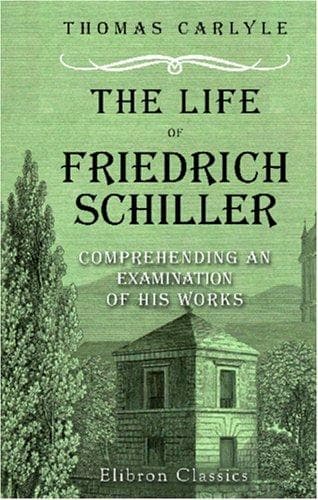
The Life of Friedrich Schiller: Comprehending an Examination of His WorksCarlyle, Thomas
General
The Life of Friedrich Schiller: Comprehending an Examination of His Works
Carlyle, Thomas
Authors, German -- 18th century -- Biography; Schiller, Friedrich, 1759-1805; Schubart, Christian Friedrich Daniel, 1739-1791
Among the writers of the concluding part of the last century there is
none more deserving of our notice than Friedrich Schiller.
Distinguished alike for the splendour of his intellectual faculties,
and the elevation of his tastes and feelings, he has left behind him
in his works a noble emblem of these great qualities: and the
reputation which he thus enjoys, and has merited, excites our
attention the more, on considering the circumstances under which it
was acquired. Schiller had peculiar difficulties to strive with, and
his success has likewise been peculiar. Much of his life was deformed
by inquietude and disease, and it terminated at middle age; he
composed in a language then scarcely settled into form, or admitted to
a rank among the cultivated languages of Europe: yet his writings are
remarkable for their extent and variety as well as their intrinsic
excellence; and his own countrymen are not his only, or perhaps his
principal admirers. It is difficult to collect or interpret the
general voice; but the World, no less than Germany, seems already to
have dignified him with the reputation of a classic; to have enrolled
him among that select number whose works belong not wholly to any age
or nation, but who, having instructed their own contemporaries, are
claimed as instructors by the great family of mankind, and set apart
for many centuries from the common oblivion which soon overtakes the
mass of authors, as it does the mass of other men.
Such has been the high destiny of Schiller. His history and character
deserve our study for more than one reason. A natural and harmless
feeling attracts us towards such a subject; we are anxious to know how
so great a man passed through the world, how he lived, and moved, and
had his being; and the question, if properly investigated, might yield
advantage as well as pleasure. It would be interesting to discover by
what gifts and what employment of them he reached the eminence on
which we now see him; to follow the steps of his intellectual and
moral culture; to gather from his life and works some picture of
himself. It is worth inquiring, whether he, who could represent noble
actions so well, did himself act nobly; how those powers of intellect,
which in philosophy and art achieved so much, applied themselves to
the every-day emergencies of life; how the generous ardour, which
delights us in his poetry, displayed itself in the common intercourse
between man and man. It would at once instruct and gratify us if we
could understand him thoroughly, could transport ourselves into his
circumstances outward and inward, could see as he saw, and feel as he
felt.
Public-domain text, read in full here on John Shaqi.
Reviews
Reviews
No reviews yet
Be the first to share your thoughts on this work.
Join the Discussion
Join the discussion
Sign in to leave a comment or review.
Sign InorCreate an account