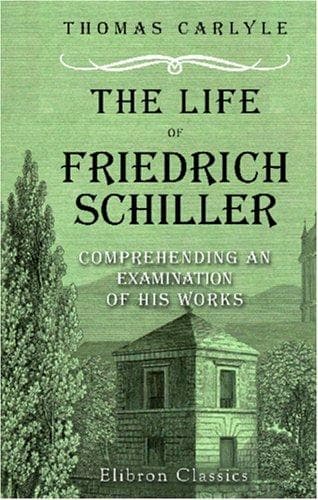
The Life of Friedrich Schiller: Comprehending an Examination of His WorksCarlyle, Thomas
General
The Life of Friedrich Schiller: Comprehending an Examination of His Works
Carlyle, Thomas
Authors, German -- 18th century -- Biography; Schiller, Friedrich, 1759-1805; Schubart, Christian Friedrich Daniel, 1739-1791
In the composition of _Fiesco_, Schiller derived the main part of his
original materials from history; he could increase the effect by
gorgeous representations, and ideas preëxisting in the mind of his
reader. Enormity of incident and strangeness of situation lent him a
similar assistance in the _Robbers_. _Kabale und Liebe_ is destitute
of these advantages; it is a tragedy of domestic life; its means of
interesting are comprised within itself, and rest on very simple
feelings, dignified by no very singular action. The name,
_Court-Intriguing and Love_, correctly designates its nature; it aims
at exhibiting the conflict, the victorious conflict, of political
manœuvering, of cold worldly wisdom, with the pure impassioned
movements of the young heart, as yet unsullied by the tarnish of
every-day life, inexperienced in its calculations, sick of its empty
formalities, and indignantly determined to cast-off the mean
restrictions it imposes, which bind so firmly by their number, though
singly so contemptible. The idea is far from original: this is a
conflict which most men have figured to themselves, which many men of
ardent mind are in some degree constantly waging. To make it, in this
simple form, the subject of a drama, seems to be a thought of
Schiller's own; but the praise, though not the merit of his
undertaking, considerable rather as performed than projected, has been
lessened by a multitude of worthless or noxious imitations. The same
primary conception has been tortured into a thousand shapes, and
tricked out with a thousand tawdry devices and meretricious ornaments,
by the Kotzebues, and other 'intellectual Jacobins,' whose
productions have brought what we falsely call the 'German Theatre'
into such deserved contempt in England. Some portion of the gall, due
only to these inflated, flimsy, and fantastic persons, appears to have
acted on certain critics in estimating this play of Schiller's. August
Wilhelm Schlegel speaks slightingly of the work: he says, 'it will
hardly move us by its tone of overstrained sensibility, but may well
afflict us by the painful impressions which it leaves.' Our own
experience has been different from that of Schlegel. In the characters
of Louisa and Ferdinand Walter we discovered little overstraining;
their sensibility we did not reckon very criminal; seeing it united
with a clearness of judgment, chastened by a purity of heart, and
controlled by a force of virtuous resolution, in full proportion with
itself. We rather admired the genius of the poet, which could elevate
a poor music-master's daughter to the dignity of a heroine; could
represent, without wounding our sense of propriety, the affection of
two noble beings, created for each other by nature, and divided by
rank; we sympathised in their sentiments enough to feel a proper
interest in their fate, and see in them, what the author meant we
should see, two pure and lofty minds involved in the meshes of vulgar
Public-domain text, read in full here on John Shaqi.
Reviews
Reviews
No reviews yet
Be the first to share your thoughts on this work.
Join the Discussion
Join the discussion
Sign in to leave a comment or review.
Sign InorCreate an account