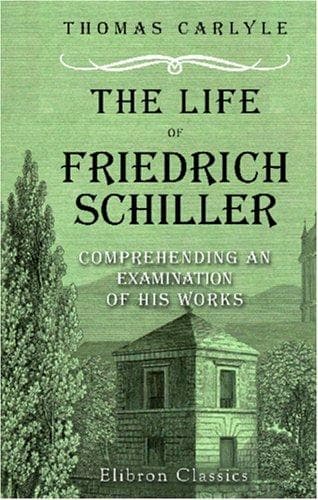
The Life of Friedrich Schiller: Comprehending an Examination of His WorksCarlyle, Thomas
General
The Life of Friedrich Schiller: Comprehending an Examination of His Works
Carlyle, Thomas
Authors, German -- 18th century -- Biography; Schiller, Friedrich, 1759-1805; Schubart, Christian Friedrich Daniel, 1739-1791
The profession of theatrical poet was, in his present circumstances,
particularly favourable to the maintenance of this wholesome state of
mind. In the fulfilment of its duties, while he gratified his own
dearest predilections, he was likewise warmly seconded by the
prevailing taste of the public. The interest excited by the stage, and
the importance attached to everything connected with it, are greater
in Germany than in any other part of Europe, not excepting France, or
even Paris. Nor, as in Paris, is the stage in German towns considered
merely as a mental recreation, an elegant and pleasant mode of filling
up the vacancy of tedious evenings: in Germany, it has the advantage
of being comparatively new; and its exhibitions are directed to a
class of minds attuned to a far higher pitch of feeling. The Germans
are accused of a proneness to amplify and systematise, to admire with
excess, and to find, in whatever calls forth their applause, an
epitome of a thousand excellencies, which no one else can discover in
it. Their discussions on the theatre do certainly give colour to this
charge. Nothing, at least to an English reader, can appear more
disproportionate than the influence they impute to the stage, and the
quantity of anxious investigation they devote to its concerns.
With us, the question about the moral tendency of theatrical
amusements is now very generally consigned to the meditation of
debating clubs, and speculative societies of young men under age; with
our neighbours it is a weighty subject of inquiry for minds of almost
the highest order. With us, the stage is considered as a harmless
pastime, wholesome because it occupies the man by occupying his
mental, not his sensual faculties; one of the many departments of
fictitious representation; perhaps the most exciting, but also the
most transitory; sometimes hurtful, generally beneficial, just as the
rest are; entitled to no peculiar regard, and far inferior in its
effect to many others which have no special apparatus for their
application. The Germans, on the contrary, talk of it as of some new
organ for refining the hearts and minds of men; a sort of lay pulpit,
the worthy ally of the sacred one, and perhaps even better fitted to
exalt some of our nobler feelings; because its objects are much more
varied, and because it speaks to us through many avenues, addressing
the eye by its pomp and decorations, the ear by its harmonies, and the
heart and imagination by its poetical embellishments, and heroic acts
and sentiments. Influences still more mysterious are hinted at, if not
directly announced. An idea seems to lurk obscurely at the bottom of
certain of their abstruse and elaborate speculations, as if the stage
were destined to replace some of those sublime illusions which the
progress of reason is fast driving from the earth; as if its
pageantry, and allegories, and figurative shadowing-forth of things,
might supply men's nature with much of that quickening nourishment
Public-domain text, read in full here on John Shaqi.
Reviews
Reviews
No reviews yet
Be the first to share your thoughts on this work.
Join the Discussion
Join the discussion
Sign in to leave a comment or review.
Sign InorCreate an account