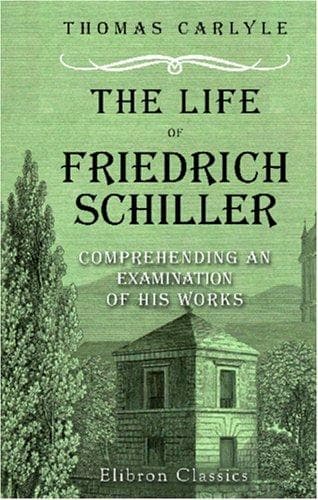
The Life of Friedrich Schiller: Comprehending an Examination of His Works — John Shaqi
The Life of Friedrich Schiller: Comprehending an Examination of His WorksCarlyle, Thomas
General
The Life of Friedrich Schiller: Comprehending an Examination of His Works
Carlyle, Thomas
Authors, German -- 18th century -- Biography; Schiller, Friedrich, 1759-1805; Schubart, Christian Friedrich Daniel, 1739-1791
In particular, the _Philosophische Briefe_, written about this period,
exhibits Schiller in a new, and to us more interesting point of view.
Julius and Raphael are the emblems of his own fears and his own hopes;
their _Philosophic Letters_ unfold to us many a gloomy conflict that
had passed in the secret chambers of their author's soul. Sceptical
doubts on the most important of all subjects were natural to such an
understanding as Schiller's; but his heart was not of a temper to rest
satisfied with doubts; or to draw a sorry compensation for them from
the pride of superior acuteness, or the vulgar pleasure of producing
an effect on others by assailing their dearest and holiest
persuasions. With him the question about the essence of our being was
not a subject for shallow speculation, charitably named scientific;
still less for vain jangling and polemical victories: it was a fearful
mystery, which it concerned all the deepest sympathies and most
sublime anticipations of his mind to have explained. It is no idle
curiosity, but the shuddering voice of nature that asks: 'If our
happiness depend on the harmonious play of the sensorium; if our
conviction may waver with the beating of the pulse?' What Schiller's
ultimate opinions on these points were, we are nowhere specially
informed. That his heart was orthodox, that the whole universe was for
him a temple, in which he offered up the continual sacrifice of devout
adoration, his works and life bear noble testimony; yet, here and
there, his fairest visions seem as if suddenly sicklied over with a
pale cast of doubt; a withering shadow seems to flit across his soul,
and chill it in his loftiest moods. The dark condition of the man who
longs to believe and longs in vain, he can represent with a
verisimilitude and touching beauty, which shows it to have been
familiar to himself. Apart from their ingenuity, there is a certain
severe pathos in some of these passages, which affects us with a
peculiar emotion. The hero of another work is made to express himself
in these terms:
Public-domain text, read in full here on John Shaqi.
Reviews
Reviews
No reviews yet
Be the first to share your thoughts on this work.
Join the Discussion
Join the discussion
Sign in to leave a comment or review.
Sign InorCreate an account