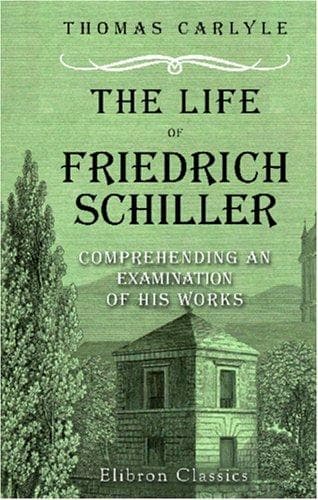
The Life of Friedrich Schiller: Comprehending an Examination of His WorksCarlyle, Thomas
General
The Life of Friedrich Schiller: Comprehending an Examination of His Works
Carlyle, Thomas
Authors, German -- 18th century -- Biography; Schiller, Friedrich, 1759-1805; Schubart, Christian Friedrich Daniel, 1739-1791
The celebrity of Alfieri generally invites the reader of _Don Carlos_
to compare it with _Filippo_. Both writers treat the same subject;
both borrow their materials from the same source, the _nouvelle
historique_ of St. Réal: but it is impossible that two powerful minds
could have handled one given idea in more diverse manners. Their
excellencies are, in fact, so opposite, that they scarcely come in
competition. Alfieri's play is short, and the characters are few. He
describes no scene: his personages are not the King of Spain and his
courtiers, but merely men; their place of action is not the Escurial
or Madrid, but a vacant, objectless platform anywhere in space. In all
this, Schiller has a manifest advantage. He paints manners and
opinions, he sets before us a striking pageant, which interests us of
itself, and gives a new interest to whatever is combined with it. The
principles of the antique, or perhaps rather of the French drama, upon
which Alfieri worked, permitted no such delineation. In the style
there is the same diversity. A severe simplicity uniformly marks
Alfieri's style; in his whole tragedy there is not a single figure. A
hard emphatic brevity is all that distinguishes his language from that
of prose. Schiller, we have seen, abounds with noble metaphors, and
all the warm exciting eloquence of poetry. It is only in expressing
the character of Philip that Alfieri has a clear superiority. Without
the aid of superstition, which his rival, especially in the
catastrophe, employs to such advantage, Alfieri has exhibited in his
Filippo a picture of unequalled power. Obscurity is justly said to be
essential to terror and sublimity; and Schiller has enfeebled the
effect of his Tyrant, by letting us behold the most secret recesses of
his spirit: we understand him better, but we fear him less. Alfieri
does not show us the internal combination of Filippo: it is from its
workings alone that we judge of his nature. Mystery, and the shadow of
horrid cruelty, brood over his Filippo: it is only a transient word or
act that gives us here and there a glimpse of his fierce, implacable,
tremendous soul; a short and dubious glimmer that reveals to us the
abysses of his being, dark, lurid, and terrific, 'as the throat of the
infernal Pool.' Alfieri's Filippo is perhaps the most wicked man that
human imagination has conceived.
Public-domain text, read in full here on John Shaqi.
Reviews
Reviews
No reviews yet
Be the first to share your thoughts on this work.
Elsewhere in the archive
Join the Discussion
Join the discussion
Sign in to leave a comment or review.
Sign InorCreate an account